

Ann Arbor Symphony Orchestra celebrating America
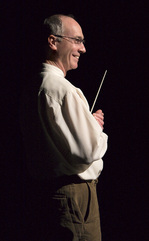
Arie Lipsky
photo courtesy of the Ann Arbor Symphony Orchestra
Bloomington, Indiana, to conduct the Bloomington Camerata Orchestra. Ashland, Ohio, to conduct the Ashland Symphony Orchestra. Ann Arbor Symphony Orchestra Music Director Arie Lipsky seemed to be making a late-February tour of the heartland in preparation for the A2SO’s “American Celebration” Saturday, March 13 at the Michigan Theater.
Or maybe he was just girding his loins for what he calls “March Madness Week,” when the A2SO plays not just its Saturday main-stage concert but 2 Thursday morning youth concerts for area school children at Hill Auditorium and a Sunday afternoon family concert back at the Michigan Theater on the 14th. That’s a lot of rehearsing and a lot of playing in a short period of time.
At all 4 concerts, Americana rules, as does a certain quintessentially American optimism.
PREVIEW |
Saturday night, March 13, at the Michigan Theater, the blues, ragtime and all that jazz come to the fore in the Gershwin Concerto in F for Piano and Orchestra; Dvorak celebrates the “New World” in his 9th symphony; and Ann Arbor’s own Pulitzer Prize-winning composer William Bolcom displays his wit and whimsy in an excerpt from “Seattle Slew: Three Dances in Forequarter Time” a orchestral-suite tribute to the legendary Triple Crown-winning horse.
The concert opens with the first of the Bolcom dances, the charmingly titled “Derby Dressage.” (The remaining 2 are the “Preakness Promenade” and the “Belmont Bourree.)”
“This is the lighter side of Bill,” Lipsky said by phone from Bloomington. (He also cryptically refers to negotiating just what type of horse will be on the stage of the Michigan …. Hmm — Guess we’ll have to show up and find out.)
“Seattle Slew,” he added, is “brilliantly orchestrated.” Bolcom, of course, is known for his love of the mix — American popular music of all sorts finds its way into his scores. The Gershwin concerto that follows “Seattle Slew” is likewise influenced by American popular forms: blues, ragtime and all that jazz.
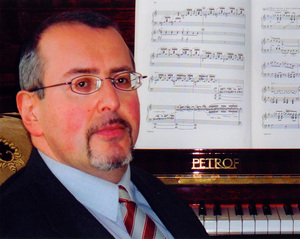
Arkadiy Figlin joins the A2SO on piano in “American Celebration” at the Michigan Theater on Saturday.
To play the piano part, Lipsky’s choice is the classically trained, jazz-savvy Arkadiy Figlin, who wowed audiences here with the Gershwin “Rhapsody in Blue” in the A2SO’s 2006-07 season.
He constantly wows Lipsky, who works side by side with him every summer at the Chautauqua Institution in New York state, and where Figlin just happens to practice in the Gershwin Shack, where the composer wrote much of the Concerto in F in the 1920s.
“I know that Gershwin used to complain about performances of both his Concerto in F and “Rhapsody in Blue” that they were too straight-laced,” said Lipsky. “They didn’t have the right spirit. Well, we will not have this problem with Arkadiy Figlin.”
Figlin plays a lot of jazz in New York clubs (and records jazz, too, sometimes alongside classical selections.) His jazz orientation can lead to some surprises onstage for the conductor, as Lipksy has found out to his pleasure and consternation.
“Especially when he plays Gershwin, you never know what you get, he just takes off,” Lipsky said. “Luckily, he does it mainly in the cadenzas. But it can be a trick to know when to bring the orchestra in. That’s a big sort of sweat for me, and he does like to tease me.”
Dvorak is not an American composer, but he did live and work here for a number of years. Lipsky surmises the importance of that experience from the fact that Dvorak, unlike predecessors who simply numbered their symphonies, titled his Ninth Symphony “From the New World,” just as he titled one of his string quartets “The American.”
“It shows how strong he felt about America,” Lipsky said. And of course, he uses American material in the “New World,” though, as Lipsky said, “It’s still a Slavic symphony. He can’t help it.”
When Lipsky conducts this mainstay of the symphonic repertoire, it will be his first return to it since he conducted it on a memorable occasion 2 years ago. He was invited to conduct the Arthur Rubinstein Philharmonic Orchestra in Lodz, Poland, his parents’ home town and the city from which his father was deported to Auschwitz in 1941 during the Holocaust. The concert was a Holocaust commemoration; however, his 88-year-old father, who survived Auschwitz and emigrated to Israel, had said he would never return to Poland for any reason. But he agreed to come. His father was honored at the concert and spoke to the audience. Lipsky chose to conduct the Dvorak “New World,” among other pieces, to celebrate hope and a changed world.
The day after the concert, Lipsky related, he and his father, accompanied by other family members, searched for — and found — his grandfather’s gravestone in a Lodz cemetery. When the family left the cemetery, they were recognized by some local people.
“One lady approached my dad and began to speak to him in Polish and started crying,” Lipsky recalled. She said, ‘Forgive us, please, I’m so ashamed what we did to you,’ and she went on and on so that my dad started crying and started comforting her. He said, ‘We survived, and here are my kids and my grandkids.’ We all started crying then. It was a very emotional experience.”
Watch a video preview, in which Thomas Blaske discusses the concert with Music Director Arie Lipsky:
Susan Isaacs Nisbett is a free-lance writer who covers classical music and dance for AnnArbor.com.