

Why Detroit's revitalization is important to Ann Arbor (and how Ann Arbor can help)
The revitalization of Detroit is not a philanthropic initiative.
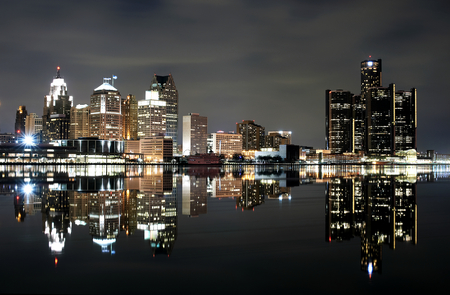
The downtown Detroit skyline is seen here from across the Detroit River in Windsor, Ontario, Canada.
Dmason2006 | Dreamstime.com
And, yes, private investment in corporate infrastructure — much like investments by the DeVos, Van Andel and Meijer families in Grand Rapids — is also needed, and surprisingly missing, in Detroit.
But perhaps the most important element to sparking a turnaround in Detroit is regional collaboration.
And a key catalyst in that turnaround is Ann Arbor — its business community, its nonprofit leaders and, yes, the University of Michigan.
Ann Arbor has role to play in Detroit's revitalization
- Why Detroit's revitalization is important to Ann Arbor (and how Ann Arbor can help)
- Detroit's physical restoration would create jobs for Ann Arbor region
- Ann Arbor nonprofits, universities, businesses can help reinvent Detroit public school system
- Public-private partnerships offer collaborative opportunities for Ann Arbor, Detroit
- A vibrant Detroit would make it easier for Ann Arbor companies to attract talented young professionals
Regional business leaders, politicians, nonprofit executives and educators will gather Wednesday through Friday on Mackinac Island to discuss a variety of issues, including the revitalization of Detroit, at the Detroit Regional Chamber’s annual Mackinac Policy Conference.
The conference’s marquee panel event - historically called the Big Four —usually features the region’s top four political executives: the mayor of Detroit and county executives from Wayne, Oakland and Macomb.
But for the first time this year, the panel is adding a fifth participant: Conan Smith, chairman of the Washtenaw County Board of Commissioners. It’s a clear acknowledgment of Washtenaw County’s role in leading a regional recovery.
Ann Arbor, to be sure, is a beacon of metro Detroit’s economy — and that’s not going to change. U-M is a constant source of world-class talent and technology, the entrepreneurial community is growing, the health care industry is rapidly adding jobs and the housing market seems to have finally stabilized.
Nonetheless, Ann Arbor stands to benefit from Detroit’s recovery — a reality we need to grasp. And Detroit stands to benefit from a stronger Ann Arbor.
“By far the most important thing by far is for folks in Washtenaw County to understand that they’re part of the metro Detroit region because that’s still a struggle here,” said Lou Glazer, president of Ann Arbor-based nonpartisan think tank Michigan Future. “That’s No. 1. No. 2 is to understand that successful, prosperous regions are anchored by vibrant, central cities. What happens in the city of Detroit matters to the economic well being of people in the entire region, not just the city of Detroit.”
In other words, we need to care about Detroit if for no other reason than our futures are intertwined.
“Ann Arbor is fantastic at drawing talented young people to Michigan,” Smith said. “And yet we lose them all the time to Chicago, to New York, to L.A., to Austin, to D.C. And one of the big reasons we lose them is we don’t have a strong core city that can offer them the vital urban experience that they’re craving.”
2011 Mackinac Policy Conference
The Detroit Regional Chamber of Commerce is hosting its annual Mackinac Policy Conference
on Mackinac Island from Wednesday through Friday. One of the key issues
to be discussed is the revitalization of Michigan’s distressed urban
environments, including Detroit. Watch AnnArbor.com for coverage of the
conference by Business News Director Nathan Bomey.
Conference speakers include Michigan Gov. Rick Snyder, United Auto Workers President Bob King, Meijer Inc. President Mary Murray, Wayne County Executive Bob Ficano, Oakland County Executive Brooks Patterson, Michigan Future President Lou Glazer, U.S. Sens. Carl Levin and Debbie Stabenow, Detroit Mayor Dave Bing, Michigan Economic Development Corp. CEO Michael Finney and Ford Motor Co. Executive Chairman Bill Ford Jr.
Consider these 5 reasons why the future of Detroit matters to the future of Ann Arbor:
1. The physical restoration of Detroit means more jobs for Ann Arbor.
The construction industry is the obvious example of a sector that will benefit significantly from Detroit’s revitalization, which will include demolition of thousands of abandoned homes and commercial buildings and construction of new developments.
But other companies — such as marketing firms, consulting agencies and technology service providers — could reap more business from a stronger Detroit.
Skeptical? Imagine this: What would happen to companies based in Evanston, Ill., home to Northwestern University, if Chicago were in disrepair? They’d be doomed.
If Detroit is “on the path to being a great city,” as former Ann Arbor venture capitalist and Gov. Rick Snyder likes to put it, Ann Arbor’s job market will improve.
Construction firms like entrepreneur Stewart Beal’s Ann Arbor-based Beal Inc. — which is demolishing abandoned homes in Detroit, renovating houses and winning contracts for various renovation projects in Detroit — are already taking advantage of opportunities in the Motor City.
“That’s the reason that my company has grown from one employee to now more than 150 employees,” Beal said. “It’s directly correlated with work that’s going on in Detroit.”
If we have any hope of fostering the creation of an “Aerotropolis,” a cluster of shipping and logistics businesses surrounding Willow Run Airport and the Detroit Metro Airport, we need a second bridge over the Detroit River to manage projected increases in truck traffic.
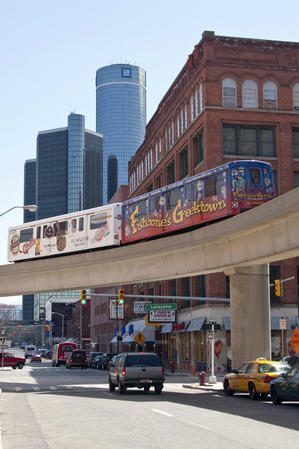
The People Mover crosses Beaubien Street at Lafayette in Greentown In downtown Detroit with General Motors' headquarters at the Renaissance Center in the background.
Steve Pepple | AnnArbor.com
And Canada has agreed to give us up to $550 million to pay for Michigan’s half of the bridge — funding that can count as Michigan’s required matching funds to ensure the continued delivery of U.S. roadwork dollars.
Companies in U.S. Rep. John Dingell’s 15th Congressional District in 2009 sold $6 billion in goods to Canada, which underscores the importance of a new Detroit-to-Windsor bridge to the Ann Arbor region’s business community.
It seems blatantly obviously that the U-M School of Education, for example, could play a role in reshaping the dreadful Detroit public school system.
Other Ann Arbor groups are already contributing to the public school system’s reinvention.
Michigan Future is launching eight new college-preparatory high schools in Detroit. It’s a case study in how innovative thinking and a comparatively small pot of philanthropic funding can provide an alternative for students who are typically relegated to failing schools.
The U-M Medical School recently revealed that it’s in talks to provide forensic medical services for the Wayne County Medical Examiner’s Office, which performs more than 2,000 autopsies a year. The deal — which must be approved by the Wayne County Commission — would save millions and provide invaluable skills to U-M students.
Ben Erulkar, the Detroit Regional Chamber’s new senior vice president for economic development, said collaboration opportunities are abundant.
“The idea of regional collaboration needs to be moved in this region beyond lip service and towards programs with measurable results,” Erulkar said. “One of my great goals is to ensure that happens between Ann Arbor and Detroit and vice versa. That would be — for me, for the chamber and for the region — something that could change the game in terms of Detroit’s rebuilding and recovery and Ann Arbor’s growth and reputation for being a hotbed for innovation and top-notch economic development.”
Research conducted by Michigan Future shows that about 11 percent of Michigan’s top college graduates leave for Chicago — our top regional nemesis by far.
But if Detroit could channel just a bit of Chicago’s allure, it would be easier for Ann Arbor tech companies to convince talented young people to stick around to work here.
“People in Ann Arbor have got to understand that that having a vibrant Detroit matters and the main reason it matters is young professionals’ increasing preference, before they have kids, to live in central cities,” Glazer said. “So if Detroit doesn’t work, they’re going to Chicago. Period.”
Contact AnnArbor.com's Nathan Bomey at (734) 623-2587 or nathanbomey@annarbor.com. You can also follow him on Twitter or subscribe to AnnArbor.com's newsletters.
Comments
thorj97
Mon, May 30, 2011 : 3:58 p.m.
If we want to address the issue realistically, we have to acknowledge the magnitude of the decline, and the vast amount of resources it would take to actually turn Detroit into a mini-Chicago. AA, and Michigan, would definitely benefit from a Chicago-like Detroit. However, Detroit has been in decline for something like 60 years (Truman administration), and the decline hasn't stopped yet. If the decline would be stopped tomorrow and the "rebuild" would be accomplished in half the time of the decline, it will take 30 years. The young people who are fleeing to Chicago might be grandparents. Detroit shouldn't be abandoned, but you can't fault people who don't want to place a bet on this multi-generational project with an uncertain chance of success.
WhyCan'tWeBeFriends
Mon, May 30, 2011 : 7:01 a.m.
@Gfellow.com, completely agree. A LARGE city of substance and vitality is what this region needs. Ann Arbor has its merits but it is all so student-oriented that it can't be the true catalyst. I overheard an "older" young person saying one summer that it is really dead in AA when the students are gone. That is essentially early May through Labor Day. What city can do the job when the energy is missing for 1/3 of the year? Detroit was respected and world class at one time. It can come back. I don't know how but other cities have done it. I am thinking Pittsburgh; they figured it out. I am not from here but have lived here now over 10 years. I agree with braggslaw too but am simplistic enough to think that just establishing non-corrupt government in the city should start the turnaround so desperately needed. What do I know though?
pbehjatnia
Mon, May 30, 2011 : 4:16 a.m.
I would love to see this nonsense published in the Birmngham or Troy area. Only in Ann Arbor can we be guilted into feeling responsible for Detroit and the mess it became decades ago. Yes, decades. Ann Arbor does not need Detroit. Detroit needs Ann Arbor and frankly I am over giving. We have more than enough problem zones in Washtenaw County that need fixing. Detroit is a hopeless corrupt racially motivated mess. I say annex it to Canada.
FredMax
Mon, May 30, 2011 : 1:53 a.m.
"Regional business leaders, politicians, nonprofit executives and educators will gather Wednesday through Friday on Mackinac Island to discuss a variety of issues, including the revitalization of Detroit" A worrysome indicator; all kinds of facilities in Detroit, and they choose... Mackinac Island!
Mike
Sun, May 29, 2011 : 10:16 p.m.
Oh dear God. not another article advocating more investment in Detroit? Please let's just give Detroit back to Canada. Detroit is a wasteland. It is a perpetual sink hole of people, culture and money. Let it go. It is time to build upon firmer ground. If we cannot donate Detroit and its dysfunctional culture to some hapless party, let's just decide to invest in it no more. Detroit is Michigan's bad child that went from bed wetting to theft to violence and finally to spiraling collapse. We do it best mercy by enabling it no longer. Let Detroit finally die, its people disperse and burden more affluent populations with perhaps less tolerance for their bad habits. Let Michigan move on to firming its connection with Chicago. There is a thriving metropolis! Let us establish finally a train line that no longer waits for freight. There is no need for "high speed rail". There is simply the need to negotiate priority of people over cattle.
Ben Alfaro
Mon, May 30, 2011 : 1:28 a.m.
100% disagreed. I'd bet you spend little to no time in Detroit, too.
mohomed
Sun, May 29, 2011 : 10:45 p.m.
Way to tell it like it is! Most hippies in Ann Arbor won't agree with you though but they sure as heck would be caught dead living in Detroit or over in the other side of town called Ypsilanti, LOL.
Ming Bucibei
Sun, May 29, 2011 : 9 p.m.
A hopeless basket case Plow detroit under, as has been suggested by people in detroit, it is not a lack of funding but rather crooked politicans corruption, graft, misdirected projectes, misfeasance & malfeasance that are the problems!! It is not the people, it is the corruption, bad schools, bad politicans......etc.....the people are the only ones that can turn it around--but they must do it for themselves!! It is like a war zone there and has be so for 30+ years, & steadly getting worse as time progressed Considering the state of detroit, a second bridge to canada is sheer folly; a total waste of taxpayer funds as is any rapid rail system--just money into a black hole!!-- let private funding build the bridge, rails systems & resurect detroit but it would be a very bad investment!! Ming Bucibei
Macabre Sunset
Sun, May 29, 2011 : 7 p.m.
Yes, Ann Arbor would benefit from a revitalized Detroit. Absolutely. The cost of revitalizing Detroit would be greater than the current national debt. Ann Arbor would benefit more from spending far less elsewhere.
debling
Sun, May 29, 2011 : 6:55 p.m.
Like it or not here is what it comes down to. Good schools have good kids. Good kids come from good families. Good families are made up of good people that care about their families, friends and communities. Good cities have good neighborhoods. Good neighborhoods are built from good families. Good families are made up of good people that care about their families, friends and communities. Detroit can only change from within, by the people that live there.
LNE1313
Sun, May 29, 2011 : 6:18 p.m.
I was a student teacher for a semester in Detroit, and it is true that parents are a problem in Detroit. Parents would refuse to come to parent-teacher conferences, claiming that they 'were too busy.' However, according to other staff, a large percentage of those parents were unemployed and relying on welfare. As a teacher I felt everything I managed to achieve in class went back down to zero when the students went back home and had to deal with their daily lives at home. The lack of parental involvement, or the wrong kind, is detrimental to improvement. Parents who themselves have had a negative and unsuccessful educational experience will find little importance to encourage their children to pursue knowledge. Youth should be considered assets to a city! Yet, in high school so many students just stop showing up, finding that there are more valuable ways to spend their time, and their activities hurt rather than help the city. My suggestions: 1) Boarding schools, so that progress is not lost every time students go home, and so that students are in safe environments with successful role models and with constant reminders of their personal goals. 2) Adult education. Give young moms (and others) a second chance to do something with their lives. 3) Phase out/minimize welfare benefits. Detroit cannot and should not sustain this. 4) Transportation system. I honestly do not claim to know much about this bridge, but what I HAVE experienced is that a Metro system creates many, many jobs, allows people to get to their jobs and is more environmentally sound than relying only on cars. With a new start can come a new image. 5) Cut down on crime. My understanding is that Bing has already begun to work on this by ensuring that police officers live within the city. 6) Use the media as an advantage to discourage any behavior that is detrimental to the improvement of Detroit. Speaking to the students, all are proud of Detroit. Appealing to patriotism can prove effective.
Ben Alfaro
Sun, May 29, 2011 : 5:02 p.m.
Having been born and raised in Ann Arbor and a student in Detroit since 2008, I can wholeheartedly say that the lack or cooperation between Detroit and the suburbs definitely has a business and financial factor, but is rooted in the longstanding racial difference between the areas. The history of Detroit is racist. Blacks worked the hardest, menial jobs, saw blatant blockbusting and redlining of their communities, saw neighborhoods literally build walls between black and white areas, etc. As a result of this, white and black flight has occurred in the city, fueling a war of the tongue pinning its downfall on the people of Detroit. Let me be clear: the PEOPLE of Detroit are honest, hard-working, creative people eager to see he city succeed. The corporate, political, and regional stigmas that allow the type of language that calls for simply changing who lives there is problematic and racist. It is Ann Arbor's - but also Macomb and Livingston counties, MANNY MAROUN, L. Brooks Patterson and Rick Snyder's utmost responsibility to support this region by supporting this city. The divisive post-industrial abandonment of Detroit by all outside entities is the brunt of Michigan's shame.
braggslaw
Sun, May 29, 2011 : 8:29 p.m.
You can say what you want.. I am in Detroit weekly #2 in violent crime (#1 is Flint) worst schools in the country some of the highest paid teachers in the country corruption at ever level of govt. (now even the Detroit library dirt is ...) Triple the average for the amount of city employees for a city of comparable size. Look, I want Detroit to be better. I just don't see how. The people that are left are the ones that could not leave.
Ron Granger
Sun, May 29, 2011 : 4:43 p.m.
How do you move forward with a system that is rife with corruption? One where every program must include extra budget for payoffs to those who feel they are entitled for one reason or another. We saw that when the State of Michigan wanted to fix Cobo Hall. The corrupt forces in and around government obstructed the project unless they got their cut. They were willing to stop the project entirely, regardless of consequences, unless they got their slice of the pie and control. Some of those corrupt forces have been moved aside, but there haven't been nearly enough prosecutions, nearly enough purging. So, serious question... How do you deal with a horribly corrupt system where those in power often put their personal interests first?
Thick Candy Shell
Mon, May 30, 2011 : 1:24 a.m.
I know a few contractors who work in Detroit who need to "Pay" the inspectors to show up so they can get the job done. It starts at the top and goes all the way down to the workers.
Gfellow
Sun, May 29, 2011 : 3:51 p.m.
What a pleasure to read a really commonsense, well written opinion on Detroit and the impact its well-being has on the entire state of Michigan. Annarbor.com must be coming of age. I have been the victim of so many casual conversations in which the complete abandonment of Detroit is seriously entertained as a viable option by proponents. Such nonsense is hard to listen to, and is usually clad in the new speak of covert racism. The only pleasure I receive from such pablum is turning on my heel and walking away. Can there be any other country in the World which has a major city in the act of imploding on the scale that is happening in Detroit? Here is a city that has a natural geographical trade hub and is imbued with a massive fresh water resource in a State blessed with huge natural gas reserves. Furthermore, Detroit is blessed with a unique art and music culture that has spread across the World. I am at a complete loss to understand what is it about Detroit's revitalization that some Michiganders don't get.
LNE1313
Mon, May 30, 2011 : 3:35 a.m.
I appreciate your optimism Gfellow. I don't think its a coincidence that young minds are also innovative minds and also the people who are beginning to make positive changes in Detroit. Changes are beginning from the inside out and center around the arts and popular culture. It is a good move that Detroit's budget proposal did not cut spending on the arts. A question: Why is optimism such as yours so quickly dismissed as naiveté? It is a fortunate thing that some can see opportunity despite others' tendency for cynicism.
braggslaw
Sun, May 29, 2011 : 9:38 p.m.
ditto
Edward R Murrow's Ghost
Sun, May 29, 2011 : 9:28 p.m.
Aside from the fact that a smelt is a small fish . . . Exactly the mature reply I expected. Good Job. Good Night and Good Luck
braggslaw
Sun, May 29, 2011 : 8:25 p.m.
The one who smelt it dealt it...
Edward R Murrow's Ghost
Sun, May 29, 2011 : 4:37 p.m.
Don't like the "card"? Don't play it. Good Night and Good Luck
braggslaw
Sun, May 29, 2011 : 4:27 p.m.
Only a matter of time before that card was played
Technojunkie
Sun, May 29, 2011 : 1:38 p.m.
For a must-read description of the education problems and solutions in major cities read this article by Joel Klein in NYC: <a href="http://www.theatlantic.com/magazine/print/2011/06/the-failure-of-american-schools/8497/" rel='nofollow'>http://www.theatlantic.com/magazine/print/2011/06/the-failure-of-american-schools/8497/</a> He's more optimistic than I am. I agree with braggslaw's post. But if you must Do Something Klein's article is a good start.
InsideTheHall
Sun, May 29, 2011 : 12:54 p.m.
Nice try Nathan but this reads as an essay absent of concrete evidence of the claims made. Those 5 reasons....really? 1. Show us the evidence about your Evanston claim. Economic growth from tearing down abandoned houses...seriously? 2. There is a need for a third bridge for transport of goods. Let the private sector use private capital instead of public sector debt dollars. If federal debt dollars are used can we get the Michigan Congressional delegation to pledge to ban the hauling of Canadian trash to Michigan landfills???? 3. If Robert Bob could not fix DPS nobody can. DPS will not be fixed until the root cause is fixed.....the breakdown of the family unit. Before we start throwing bucks against the graffiti walls lets enlist the pastors of Detroit to teach values. 4. Oh, Detroit crime and murder rate will spur economic growth no we are beyond the pale. Consolidation does not always bring efficiency, especially in the public sector. Consolidation has been co-opted to increase control and reduce local choices. In many cases we trade one bureaucracy for another. Evidence the mission creep of WISD. Lastly, why dilute successful areas that already have limited resources on a Detroit "Hail Mary". 5. Again the cart is before the horse. Detroit needs to be secure and safe. The people of Detroit need to develop a sense of pride and self reliance. The Detroit City Council and School Board need to show they are capable of self government. Ann Arbor will survive and grow quite nicely w/o Detroit. We have been doing that all along. The economic core of SE Michigan is the arc from Auburn Hills to Novi to Ann Arbor. Invest in the core growth areas where the intellectual talent resides. Investing money in Detroit at this point in time and expecting miracles is a liberal pipe dream. As for urban renewal I suggest Nathan and Conan take a trip to Milwaukee.
jcj
Sun, May 29, 2011 : 12:41 p.m.
FIVE stories in a row about Detroit! Nathan do you get paid by the number of stories posted? That would explain why so many stories are rehashed.
braggslaw
Sun, May 29, 2011 : 12:04 p.m.
The entire southeast region would benefit if Detroit would turn around. That being said, unless you replace all the people in Detroit I don't see it happening. Strolling down the riverfront a few weeks ago on a weekend night was like being in the wild west. One guy was shot in the arm and many more were looking for some "action"... pretty scary stuff. I don't have a solution for adults with no skills, no work ethic, and baby mommas with 2-3 illegit kids. I know the normal compassionate crowd will criticize my post but I am in Detroit all the time and I see can't see changing adult behaviors that have been set in stone. I have an enormous amount of compassion for kids, because they can't choose their parents. The majority of children born in Detroit are born to youngle single women. Bad schools, corrupt govt. and unemployed welfare mom's all point to disaster.
Edward R Murrow's Ghost
Mon, May 30, 2011 : 3:34 p.m.
"playing the card is the first and last strategy for the status quo.." . . . says the person who played the card. Good Night and Good Luck
Marshall Applewhite
Mon, May 30, 2011 : 12:23 a.m.
You're still the only person who has mentioned anything about race. People are people. Behaviors are behaviors. Unless people are willing to confront reality and stop hiding behind buzzwords, nothing will change.
Maxwell
Sun, May 29, 2011 : 10:15 p.m.
Excuse me? You supply no facts while you cast large generalizations about the people of Detroit being "with no skills, no work ethic, and baby mommas with 2-3 illegit kids" and then you claim I'm playing the "racial card"? Really?
braggslaw
Sun, May 29, 2011 : 9:36 p.m.
playing the card is the first and last strategy for the status quo..
Marshall Applewhite
Sun, May 29, 2011 : 9:32 p.m.
He never said anything about race. Look at the stats........the people of Detroit are holding any kind of progress back.
Maxwell
Sun, May 29, 2011 : 8:56 p.m.
Your words "unless you replace all the people in Detroit I don't see it happening" doesn't seem to be any cold hard truth, rather a thinly veiled racist slur. That's the "Cold hard truth" - and yes - I suspect you'd don't like hearing it.
braggslaw
Sun, May 29, 2011 : 8:26 p.m.
People don't like the cold hard truth.
Maxwell
Sun, May 29, 2011 : 6:06 p.m.
Well - at least you didn't claim to see "welfare mom's" picking up their food stamps in a limo...
tdw
Sun, May 29, 2011 : 2:14 p.m.
You hit it on the head.I was a cop in Detroit and can say you are completely correct
timjbd
Sun, May 29, 2011 : 11:46 a.m.
"Sure, Detroit would probably benefit from an influx of philanthropic dollars to force changes in the public school system — similar to efforts in Washington, D.C., and Newark, N.J." ALL public schools would benefit from an influx of dollars considering that the current crop of Republican Governors voted into office in 2010- including Snyder- have been going in the opposite direction toward gutting public school funding more and more- following on the same set of plans developed (and implemented by Republican governors) since the Reagan administration. Which Washington, DC efforts are you referring to here? I can't speak about Newark but I live in Washington, DC. The public school system has not particularly benefitted from the explosion of privatized charter schools. At least the students haven't judging from results. <a href="http://colorlines.com/archives/2011/03/washington_dc_test_scores_gains_too_good_to_be_true.html" rel='nofollow'>http://colorlines.com/archives/2011/03/washington_dc_test_scores_gains_too_good_to_be_true.html</a> That has only served to further starve an already over-burdened public school system. These privatization schemes of Michelle Rhee (and Robert Bobb before her) have now been given ample chance to work their free market magic and are seen as either little improvement or outright failures by the residents.
outdoor6709
Sun, May 29, 2011 : 11:31 a.m.
You have to give the AA News credit. Its advocacy journalism is the best there is. The $550 million was a loan from Canada not a grant. It was expected that the US Government would put up another $1.5 billion to pay for Michigans share of the total cost. With US budget problems and John Dingel being in the minority that seems unlikely. Maybe in 12, we will elect a better Rep. Bridge traffic is down since its high point in 99. Where are the financial projections for the new bridge.? Seems a finaccial reporter could supply that data. The real " need " for the new bridge is the city of Windsor does not like the truck traffic in the city. While it is undenible true a revitalized Detroit would help the rest of the ara, most of Detroits problems were caused by bad policy by Detroit politicians. Until we see years of better governance it is hard to believe we will see any different results. Pay to play seems to be the new political game.