

Test drive: Talking vehicles can help us deal with distracted driving but won't prevent it
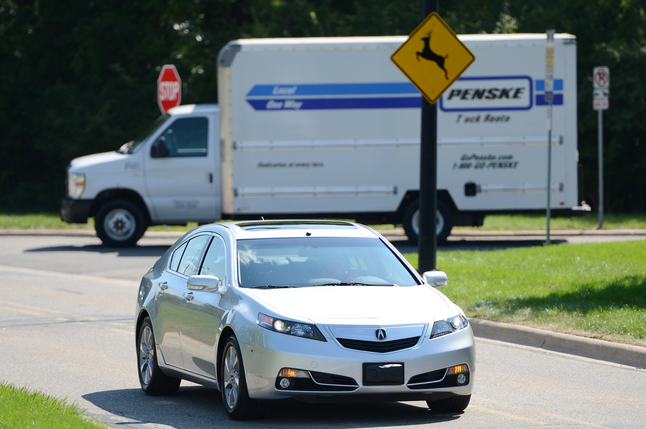
A vehicle equipped with Wi-Fi-like technology drives through a scenario at the University of Michigan Transportation Research Institute in Ann Arbor, Mich. on Tuesday, August 20, 2012.
Melanie Maxwell I AnnArbor.com
- Previous story: U.S. launches smart-car project in Ann Arbor with thousands of vehicles that talk to each other
Ann Arbor drivers probably didn't know that they could have potentially driven a brand-new Audi A4 or Mercedes-Benz 300 if they volunteered to be one of 2,800 local drivers testing groundbreaking communication devices that allow cars to talk to one another.
The chances were slim —only about 64 volunteers got the use of new vehicles with embedded devices and only a handful those were luxury brands.
But Tuesday I got the chance to ride in one of them — a Nissan Infiniti M37, which has a retail price of $48,000 for a basic model. In the back seat I got to experience vehicle-to-vehicle (V2V) technology in action when my driver, traveling at about 50 miles-per-hour, slammed on the brakes, stopping just inches short of hitting a stationary Toyota Venza.
In the split second before we stopped, I could almost hear the crunch of metal as if our vehicle had slammed into the light-blue Venza after the car ahead of us, a silver Hyundai Sonata, swerved to avoid the stationary vehicle.
Instead, I heard three short beeps and saw a small yellow icon, in the shape of a vehicle, flicker near the odometer, warning the driver to brake.
I was on a makeshift simulation track on the campus of University of Michigan's North Campus Research Complex.
The scenario, as explained by professional driver David McMillen, was this: "You're following the car right in front of you, heading down a multi-lane highway. At the very last second you get an alarm, but you don't know why. What happens is the car directly in front of us changes lanes at the very last moment and the reason they did that is because there's a stopped car in the lane we're traveling in."
We can't see the car because of the driver immediately in front of us, but the alarm lets us know something is amiss and allows us to avoid a crash.
It's the unseen and the unexpected, combining like so many factors do each day on hundreds of roadways, creating deadly tragedies.
Last year, an estimated 32,310 people died on America's roadways.
The takeaway was clear: Connected vehicles can anticipate things human drivers can't. As U.S. Transportation Secretary Ray LaHood said Tuesday while in Ann Arbor, communicating cars —which use wireless and radio devices to monitor risk through location, speed and acceleration— have the potential to save thousands of lives.
Researchers and government officials say the Ann Arbor deployment, one of the largest real-world smart-car experiments in the world, will show us how V2V technology works on the open road.
The deployment launched Tuesday and will last a year. It's being facilitated by U-M's Institute for Transportation Research and is part of a $25 million safety pilot program undertaken by the federal government. Five hundred cars outfitted with the technology are already on the road, with more to join their ranks in the weeks to come.
In another scenario, I was in the back seat of a Volkswagen GTI, which has a retail price of $24,000 for a basic model, going about 45 miles per hour when our vehicle approached a car going significantly slower, maybe 15 miles per hour. The driver heard an alert and slammed on the brakes to avoid a crash.
It was a simulation of an open-road situation in which the driver is distracted by something —whether it be a phone, noisy child or roadway sign— and doesn't notice the slower driver.
"If you're accidentally looking down and not paying much attention, and you're going to hit somebody, it should give you the warning and have you look up," said Tigran Khatchatrain, an engineer with Volkswagen.
Interestingly, the sound and appearance of a warning is an intricate science itself. The alerts need to be jolting, but not distracting. In the deployment, several different alert methods are being tested.
For example, to let drivers know there's a car in their blind-spot, some V2V-outfitted cars have small lights on the inside of the car between the window and the wheel, some have large LED lights and others have lights on the rearview mirrors.
"Whoever is putting together the driver-vehicle interface wants the messages to be concise and easy to understand," said Scott Bogard, a U-M engineer working on the deployment. "They don't want it to be distracting."
For the next simulation, Khatchatrain put on his seat belt and advised I buckle up too.
Our vehicle was going through a green light when suddenly an elongated beep and flashing "BRAKE" warning on the dashboard alerted us to danger. We braked immediately, lurching forward in our seats, as a driver sped through the intersection, running a red light.
I was thankful for the seat belt.
Clearly, V2V technology can't prevent reckless and distracted driving. But as I saw Tuesday, it can help us avoid some of the devastating consequences of such unfortunate practices.
But some ask, could it make distracted driving worse? Could it give drivers an excuse of sorts to drive distractedly?
LaHood was asked that question twice during a press conference Tuesday, and both times he refused to answer.
Why? Probably because the answer is uncertain.
Ann Mehringer, a U-M employee and Milan resident who volunteered for the study, said she doesn't think the new technology will create problems.
"This actually has a lot to do with other drivers and not necessarily you," she offered. "If someone’s going ro run a red light, you don't know," but you can prevent a collision.
Later, Gregory Winfree, deputy administrator for the Research and Innovative Technology Administration of the U.S. Department of Transportation, told me that for accident rates to fall, people and the technology have to work together.
"The first thing you have to do is get people to put their cellphones down, and the second thing you have to do is get people to understand how this technology works," he said.
Kellie Woodhouse covers higher education for AnnArbor.com. Reach her at kelliewoodhouse@annarbor.com or 734-623-4602 and follow her on twitter.
Comments
Ann English
Wed, Aug 22, 2012 : 11:33 p.m.
This kind of technology could help prevent traffic fatalities at intersections with police cars and other emergency vehicles. Years ago, in another city, police never apologized to a family for hitting a woman broadside in an intersection at night. She was killed but I don't remember all the details. The technology might detect vehicles driving the wrong way on a freeway or a stalled vehicle in the front of a line of cars. When traffic lights turn green, we naturally expect the car in front to move, so we're surprised if it doesn't and we haven't come to a complete stop ourselves yet. Even if we brake on time, the driver behind us might not. The technology can help avoid collisions if a driver is looking for an address or street to turn onto. I never heard of anyone calling this a distraction, but at least it requires the driver to slow down.
Dog Guy
Wed, Aug 22, 2012 : 7:46 p.m.
A brand-new Audi A4, Mercedes-Benz 300, or Volkswagen GTI is fine for tax-funded Ann Arbor, but can the technology be adapted to domestic cars for commoners outside of this intelligentsia refuge?
Kellie Woodhouse
Wed, Aug 22, 2012 : 8:18 p.m.
Dog Guy, Only 60-some cars in the study are new. The rest of the volunteers get their existing cars retrofitted with the devices. It's my understanding that V2V technology can be installed in virtually any vehicle. The yearlong study is looking in part at how user-friendly the different technologies are and how common folk, like myself, react to it. Thanks for reading!
LXIX
Wed, Aug 22, 2012 : 4:51 p.m.
Another story of disinformation. Yes, like the old police saying "Nobody outruns Motorola", communication of a mapped environment can add faster-than-human intelligence to those working withing it. It can also add chaos if that information is flawed or the interpreter fails to process it correctly. But If drivers processed the traffic environment correctly there would be zero need for such technology which then begs the question as to why big money is being spent on this rather than say zero-emission cars and power grid ?. The answer that this smart network will not save many lives but the personal and environment data collected will be worth billions. If it really works for any driver then why didn't the reporter drive the test car?
LXIX
Wed, Aug 22, 2012 : 7:18 p.m.
Thankyou for the in-depth news reporting Ms Woodhouse. Keep it up! The question posed was designed to put the reader in the hot seat. Would anyone risk so much for a beeping life-saver in that dangerous test? Or in real life/death encounters out on the road ? I for one wouldn't. And I am thankful that husbands do sometimes know what is best for their family. It makes too much 'cents' to not incorporate unique device ID tracking - like cell phone ESNs. Thanks again for the iinciteful A2com stories now and yet to come. This event was also in today's NY Times.
Kellie Woodhouse
Wed, Aug 22, 2012 : 5:32 p.m.
LXIX: The test drive simulated a lot of near-collisions on purpose so that I could see how the technology would alert the driver. They had freelance professional drivers behind the wheels of the vehicles, as it would not have been safe for me to try the various stunts (just ask my husband!). To respond to your concern about security and privacy, you raise a point that has been brought up repeatedly and might be worth a follow-up. I do know that the communication codes are encrypted and that there are layers of security in place so the wireless signals can't be manipulated, but I also know it remains a concern among motorist groups. Thanks for reading and offering your insights.
a2why
Wed, Aug 22, 2012 : 3:14 p.m.
Now if these cars can only talk to crosswalks...
Jim Walker
Wed, Aug 22, 2012 : 3:13 p.m.
This technology has some real possibilities for safety improvements. It also has some real possibilities for tracking every trip we take and becoming the basis for a per-mile driving fee - in addition to the fuel taxes we all pay. If instituted, this would double-dip the user fees for the use of the roads. And people who think that any tracking system is "private" or "secure" from hackers or governments are fooling themselves. James C. Walker, National Motorists Association, Ann Arbor, MI
justcurious
Wed, Aug 22, 2012 : 2:07 p.m.
"if you're accidentally looking down and not paying much attention, and you're going to hit somebody, it should give you the warning and have you look up," said Tigran Khatchatrain, an engineer with Volkswagen. accidentally???
justcurious
Wed, Aug 22, 2012 : 2:01 p.m.
"We can't see the car because of the driver immediately in front of us, but the alarm lets us know something is amiss and allows us to avoid a crash. (by slamming on the brakes). The writer describes several tests where the driver slams on the brakes. What about the cars behind that driver. There would still be an accident, seems to me.
TinyArtist
Wed, Aug 22, 2012 : 1:34 p.m.
But what happens when you bring your smart car to an abrupt halt in the real world, when it is not part of a "scenario"? There are often many cars following, both smart and dumb, that will pile into you.
Tony
Wed, Aug 22, 2012 : 3:38 p.m.
It's a choice: 100% probability that you will have an accident for which you are responsible vs. 25%+/- probability that you will have an accident for which you are not responsible. I'd choose the latter but to each his own.
xmo
Wed, Aug 22, 2012 : 12:53 p.m.
This is why they closed the road between Green and Huron Valley Parkway! Sounds interesting but do I really want to give up my right to be a bad driver?
Dave
Wed, Aug 22, 2012 : 12:34 p.m.
What ever happened to the concept that driving is a privilege and not a right as most people seem to think. Folks, today, seem to believe that while on the road, the world revolves around them, their desires and needs and everyone else can go screw themselves. Cell phone use is an example of this since so many seem to be addicted to this technology while on the road. Today's drivers don't seem to care that there are others out there whose safety depends not only upon what they, themselves, do but upon what others on the crowded roadways do. There's no point in discussing the use of turn signals while changing lanes/turning corners or anything else because those discussions will probably just draw blank stares. Besides, I wouldn't want to forcibly drag anyone away from their precious cell phone conversations.
GoNavy
Wed, Aug 22, 2012 : 3:24 p.m.
Dave- Considering that the U.S. has over 47,000 highway miles and 3.9 million miles of roads, and that everywhere you need to be that is "not your house" lies on one of these, you've got to be absolutely kidding me when you say "driving is a privilege." Rather, driving is practically a necessity. With this in mind, our legal approach to driving needs to take into consideration that the act is an economically necessary fact of life, and be regulated as such. From this perspective, it's easy to justify laws and regulations that take a holistic approach to driving and traffic, rather than the view of "the individual and his/her car" that would fall under the "driving is a privilege" paradigm. Texting, eating food, doing makeup, shaving, etc. are all great under the "You and your car" paradigm, but it does not fit at all under the "driving as an economic necessity" theme. Therefore, I believe that it is right to impose whatever regulations are necessary - including a complete ban on talking while driving, texting while driving, eating while driving, etc. -whenever those activities can be shown to create problems within the "driving as an economic necessity" paradigm. If a single individual, exercising "individual rights" within his or her car (for example, texting or eating) can create a time/economic hardship for thousands of others, then we would be justified in curtailing the individual freedom.
justcurious
Wed, Aug 22, 2012 : 2:04 p.m.
You are absolutely right Dave. This appears to me to be just another way that the government is extracting our money from us to put a band aid on the real problem - people's attitudes today and allowed use of distracting elements in the vehicle.
WalkingJoe
Wed, Aug 22, 2012 : 12:38 p.m.
Well said Dave and I agree totally. The smart technology discussed in the article will not override some people's arrogance.