

Flexibility, versatility keys to succeeding in new economy, leaders say
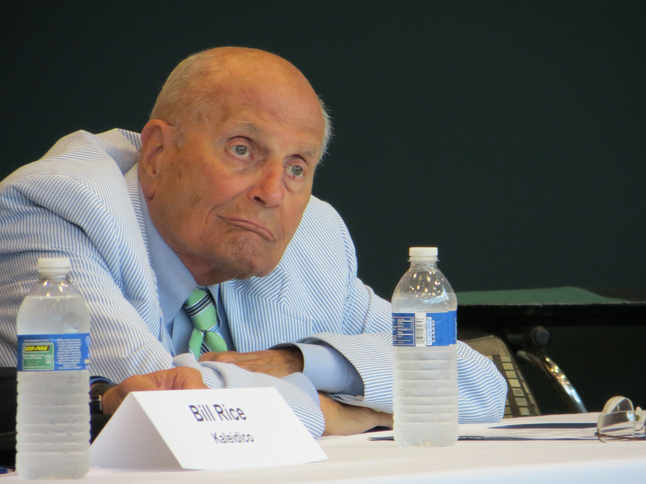
Congressman John Dingell listens to concerns from local business leaders. He said that people and businesses need to have more pride in being from Michigan.
Ben Freed | AnnArbor.com
That was one of the ideas put forth at a roundtable discussion among Ann Arbor-area business leaders and U.S. Rep. John Dingell, D-Dearborn, at Washtenaw Community College Monday afternoon.
The group discussed the impact of the technology sector on Michigan’s economy and how well colleges and universities are preparing students to enter the workforce.
The roundtable discussion was co-hosted by Google, the Michigan chapters of the Search Engine and Marketing Professionals Organization and Small Business Association, and the Michigan Small Business and Technology Development Center. Participants ranged from Eastern Michigan University professor Bud Gibson, to leaders of companies that had anywhere from 4 to 300 employees.
A number of the companies around the table were looking to expand their workforce, including search engine marketing firm Pure Visibility and home hardware online store Lookintheattic.
Kevin Woodward, director of digital strategy at marketing agency re:group, said that with an increasing blurring of the business and personal worlds, companies may need to be flexible to get the best workers.
“Talent in Michigan can be hard to find, and a lot of the Gen Y and younger people like working from home and like flexibility,” he said.
“So if you are able to and willing to build that more flexible employer/employee relationship, it will allow you to find more talent.”
Others, however, said they often find applicants in the millennial generation lacking in versatility and the willingness to fit into the company culture.
“The most valuable people aren’t silos; they’re people who are good at a lot of things, and who have good habits," said Yan Ness, CEO of data center operator Online Tech. "I’d like to see schools be more specific on attendance, because we’re seeing people who have basic habits that are missing, like showing up to work on time.”
Tom Beck, president of digital marketing agency Enlighten, agreed with Ness that workers with a combination of abilities are the most valuable.
“We want eclectic people. We’re finding more and more people who might be flash developers but also information architects and they have a good business sense,” he said.
In general, the group touted the strengths of southeast Michigan, with several calling it the ‘next Silicon Valley.’
“Michigan is a great place to start a business,” said Ness.
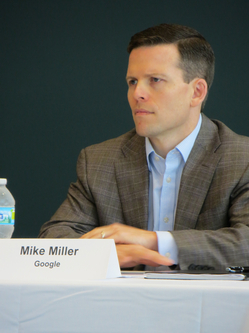
Mike Miller heads Google's Ann Arbor office.
Ben Freed | AnnArbor.com
“This group of people is the bell-weather for the economy of the region,” Dan Mahoney, vice president of membership and development for the Small Business Association of Michigan, said.
“They are all out of the ‘start-up’ stage and they’re all hiring. This is a really good sign.”
One topic that everyone was able to agree on was that the intellectual property protections currently in place in America cannot keep up with the pace of innovation in the high-tech sector.
“Patent law just wasn’t designed for what we have today,” Rep. Dingell said when the subject was brought up.
“A lot of people don’t even bother with patents these days, they use trade secrets.”
Multiple participants said they, their companies, or their clients had been sued by “patent trolls,” a term for people or companies who own patents primarily to sue deep-pocketed companies for supposed infringement.
“These are companies that just buy the patents and sue to make money,” Beck said.
“The system is utterly and completely broken. We cannot be granting patents to things with no fundamental value.”
Dingell was an active participant in the roundtable discussion and when talk turned to what the government could do to help high-tech businesses, he asked frequent questions and offered some insights into the depth of political gridlock in Washington.
“I don’t think I’d want to bring the Ten Commandments to the House floor in this political climate,” he said.
“Because one person would want to amend them and someone else would want to repeal them altogether.”
Ben Freed covers business for AnnArbor.com. Reach him at 734-623-2528 or email him at benfreed@annarbor.com. Follow him on twitter @BFreedinA2
Comments
observer
Tue, Aug 21, 2012 : 11:40 a.m.
goodness Dignell looks tired, maybe it is time to step aside....I mean he has been in office for a very long time.....during that time, Michigan continues to have these "free falls" during tough times, while other states do not.....could it be time for some new ideas to stop this "free fall."
braggslaw
Tue, Aug 21, 2012 : 3:34 a.m.
This is laughable... John Dingell the most pro-labor UAW political figure in the state talking about flexibility and productivity. Unions lead to a lack of flexiblity (1000 job classifications) and a lack of productivity (disability anyone?) What a joke.
treetowncartel
Tue, Aug 21, 2012 : 3:08 a.m.
Well, at least no one can complain about paying for retiree health benefits in this thread. I really think it is time for Dingell to groom his replacement. I'm not going to comment one way or another on his time in office, but really, it is time to move to the next level and hand the reigns of the district over to someone else.
towncryer
Tue, Aug 21, 2012 : 1:12 a.m.
I'm no Dingell fan, but could they not have found a better photo??
Itchy
Tue, Aug 21, 2012 : 3:50 p.m.
I understand that this is one of his best pictures. Must have just gotten off the phone after talking to his wife.
Dog Guy
Tue, Aug 21, 2012 : 1:31 a.m.
Indeed, towncryer, this photo would serve to advertise a new Mummy flick.
maallen
Tue, Aug 21, 2012 : 1:09 a.m.
So which one is Dingell? The one that amends the Ten Commnandments or the one that repeals the Ten Commandments? He does realize he works on the House floor, doesn't he? Meaning he is part of the gridlock problem!
katmando
Tue, Aug 21, 2012 : 12:46 a.m.
This is only for management personal only all others will get low pay, no retirement and no healthcare but still be required to work long hours. Mitt Romney 's get America working plan.
Michigan Man
Tue, Aug 21, 2012 : 12:43 a.m.
With that guy leading the jobs effort no wonder Ann Arbor has a negative 12.5% jobs growth rate. The dude looks lost, bewildered and spaced out.
Goober
Tue, Aug 21, 2012 : 11:50 a.m.
But he gets many voters behind him time & time again, doesn't he?