

One year after bankruptcy: Ex-Borders employees are taking different paths to new jobs but sticking together
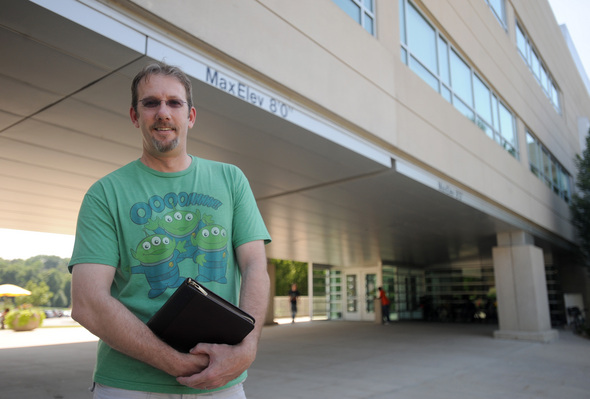
C.J. Snow stands outside of the Gunder Myran Building at Washtenaw Community College where he is taking classes toward a degree in teaching. Snow was a digital operations lead at Borders.
Angela Cesere | AnnArbor.com
This story has been updated to reflect the fact that C.J. Snow was a music buyer, rather than a book buyer at Borders. It has also been updated to clarify the fact that his wife remained employed at all times.
What do a Washtenaw Community College student, a social media coordinator at Ideation, and a corporate relations manager for Habitat for Humanity have in common? One year ago they were all working at Borders.
When the Ann Arbor-founded-and-based bookstore chain announced it was liquidating on July 18, 2011, the news sent shockwaves through the community and the literary world.
No one knew what would happen to the prime pieces of real estate that Borders occupied, or to the 400 people in the area who were soon to be without a job. Both the buildings and the people who used to work inside them have experienced mixed results.
One year later, there has been activity at all of the local retail stores. While there is no new tenant for the flagship downtown location on East Liberty Street, the property is being re-developed by a local real estate investor. The only location that is still on the market is the former headquarters on Phoenix Drive - which was listed recently for $6.9 million.
Meanwhile, most, but not all, of those who worked at Borders have found a new path. Many had to change career trajectories, some more dramatically than others.
“What can we do to help the employees get to work again?”
In early September, the Borders Next Chapter Joint Adjustment Committee was founded. The committee was comprised of representatives from the state government (who funded the committee), Ann Arbor SPARK, Michigan Works!, and Borders employees. Cynthia Pepper, a human resources and orginzational development consultant, chaired the committee.
“The goal of the committee was to ask, using the resources at our disposal from the organizations on the committee and the employees themselves, ‘What can we do to help the employees get to work again?’” Pepper said.
The committee first surveyed the former employees to get a sense of what sort of help they needed or were looking for.
“We wanted to see what skills or support people needed,” Pepper said.
“Some needed help with resumes or interviews, other people wanted to figure out whether they should retire, learn how to market themselves, or even learn to start their own business.”
The committee’s charge was to help the 400 corporate workers whose jobs were liquidated, but assistance was also offered to store employees from across the state who reached out for help. All of those involved were entering a job market that was improving, but still not strong.
There had been a steady decline in unemployment in the Ann Arbor area since levels peaked in late 2009. However, the unemployment rate was still at 6.5 percent when most of the laid off staff started looking for work. Since then, the rate has continued to fall, reaching 5.5 percent in April and May, the lowest seasonally adjusted rate since June 2008, according to the Bureau of Labor Statistics.
There were miniature job fairs held for former Borders employees, job recruiters were invited to speak to job seekers, and LinkedIn and Facebook groups were established for members of the Borders “family” to share job opportunities with each other.
The committee ceased activity at the end of February. In its final report, 46% of the laid off employees self-reported that they had found new jobs. Pepper said that number could be higher because they were only able to gather anecdotal employment numbers. There were also those who chose not to immediately re-enter the workforce.
“A completely different route”
C.J. Snow was a digital operations lead at Borders. He met his wife, Rosalynn, at Borders. He moved to Michigan in 2005 to work at Borders headquarters after working for them in the field for a number of years. The book industry was what he knew, specifically, the music side.
“Both my wife and I worked at Borders, so we would have gone from being a two-income family to a zero income family,” he said.
“I was pigeon-holed as a buyer, so to stay in Michigan and keep the same profession would have been problematic. I decided to go back to school."
Snow’s wife was in the finance department and was never unemployed. She immediately found work at a local company. He enrolled part time at Washtenaw Community College.
“I had been in my field for 25 years, so to be a student was basically brand new,” Snow said.
“But I decided that I might as well do the one other thing I had ever really wanted to do, which is teach. So I had to go back.”
Snow enrolled part time for the fall semester just two weeks after Borders shuttered. He is currently taking classes full-time at Washtenaw Community College and plans to transfer to Eastern Michigan University to pursue a degree in secondary education.
“We consider ourselves vastly lucky...” Snow said. “It could have been tragic, and it wasn’t.”
Others weren’t as lucky as Snow. While many have found new employment or career paths, others are still struggling to find their “next chapter.”
Peter Drogaris had worked at Borders for over 20 years. Now, he spends most of his time every day looking for job opportunities, posting resumes, and emailing prospective employers. He worked under contract as a writer for a local technology company, but that job ended in early June.
“I’ve stayed optimistic all along, but there are times when you get rejections and you get discouraged,” he said. “The whole thing has been really eye opening because I haven’t been in this situation since 1990.”
“We’re all still a big family”
In talking to former Borders employees, you can’t help but notice their continued devotion to each other. Members of the Borders family continue to post on the LinkedIn and Facebook groups with job openings either at their current workplace or that they’ve heard about through the grapevine.
“I got my job through a Borders colleague,” Dane Jackson, a former assistant buyer who now is the social media coordinator for Ideation in Ann Arbor, said.
“She knew there was an opening and thought I’d be a good fit for the company so she reached out to me.”
Even those who haven’t found work yet say the support system has been there for them.
“I can’t tell you how many times I’ve seen people post things or even send me personal emails when they think there’s a job description that fits me. I got one just the other day,” Drogaris said.
“It’s also common for us to get together. I’ve seen four former colleagues in the last week. It’s a network thing, and it’s also a support thing. Mostly it’s just a socialization thing.”
The Borders Foundation, now the Book Industry Charitable Foundation, was founded by Borders employees to help Borders employees in times of personal financial need. When Borders closed, the foundation decided to continue with their endowment and turned their focus to employees in both chain and independent bookstores across the nation. They also still use the $4 million endowment help former Borders employees who haven’t found their next step yet.
“We provide financial assistance and grants for a variety of things,” Alison Foreman, programs manager at the foundation, said.
“Just in the last month we’ve helped someone going through cancer treatment, helped with someone’s utility bills, and helped someone pay funeral bills for a family member.”
Like any good family, the Borders family also has reunions. The next one is planned for July 28.
“We were planning on having at the Wurst Bar in Ypsilanti, but we’ve gotten such overwhelming response that we might have to move it,” Snow said.
“We all just like to get together and party.”
This video was produced by the Borders Next Chapter JAC
Ben Freed covers business for AnnArbor.com. Reach him at 734-623-2528 or email him at benfreed@annarbor.com. Follow him on twitter @BFreedinA2
Comments
jason c dyer
Tue, Jul 17, 2012 : 4:48 a.m.
you go cuz C J Snow, i am really amazed with the loyalty of borders employees and with what they have done to help each other to get back on there feet and to stay focused on the future, i hope this system all of you have put in place spreads to other companies that are going under. i am so amazed and how well it has worked and the progress it has succeeded. keep up the good work guys and girls
shepard145
Tue, Jul 17, 2012 : 3:59 a.m.
...loyalty? - don't kid yourself. Probably more like hope for survival mixed with panic. It must be a nightmare to come into a work place every day knowing that the place is not going to make it. Ask those who work at Best Buy or Barns Nobel what their future looks like. Formulate a plan that will result in a better life - even if it takes a lot of time....prayers are with you all.
say it plain
Mon, Jul 16, 2012 : 8:32 p.m.
Okay, I'll ask it: what's an "orginzational" consultant?
Bookish Girl
Mon, Jul 16, 2012 : 3:32 p.m.
bobslowson - I know that a lot of people probably wonder why so many people stayed until the end – why they didn't see the writing on the wall and make a bigger effort to get out of there before the ship went down. I understand why they stayed. Passion. Loyalty. Hope. And, a desire to make it work, despite the odds. My position was eliminated from Borders several years ago, but if given the choice I would have stayed until the end too, because passion, loyalty, hope and books are important things in life.
Commoncents
Mon, Jul 16, 2012 : 4:06 p.m.
Blind faith can be admirable at times, but it can also be incredibly stupid. Just don't complain after you make your "passion" decision to stay and it's ok with me.
Ben Freed
Mon, Jul 16, 2012 : 2:20 p.m.
I would like to clarify that C. J. Snow did not go back to college under the duress of having no other job offers. Snow had multiple offers outside the state of Michigan, including one in Atlanta. However, due to multiple factors, he wanted to remain in the state. He had chosen to return to school prior to Borders' official closing. I apologize if there was any confusion.
bobslowson
Mon, Jul 16, 2012 : 2:02 p.m.
Anyone that worked at Borders corporate should've seen the writing on the wall long before they actually went under. In 2008 I knew the ship was sinking fast....I was lucky to get out of there in Jan 2009 (with a much better position)....so those that stuck around until the last dying day...and now can't find a job? No surprise there...it was common knowledge that the company was going to go under.
Thad McIlroy
Thu, Jul 19, 2012 : 11:08 p.m.
Why so nasty? Sure, it was common knowledge that Borders were in trouble, but it's only human to hope for a positive outcome. Bill Ackman bet over $200 million on the company, and Bennett LeBow's bet $25 million a few months before the end. Lots of companies emerge from bankruptcy after shedding debt. I congratulate you on getting out in January 2009: you got a better position; you were lucky. Clearly your job is not in human resources.
bobslowson
Mon, Jul 16, 2012 : 4:34 p.m.
@ Commoncents - my guess...bitter ex employees that went down with the ship. Took no initiative to get out before d-day. Borders was a very poorly run company from management down. The managers I had there...well I will save my comments on that one...
Commoncents
Mon, Jul 16, 2012 : 4:04 p.m.
For those that down voted this - WHY ? It's true.
sellers
Mon, Jul 16, 2012 : 11:50 a.m.
It's good to see folks remained in the area and will help start the next great thing.
Emily Mathews
Mon, Jul 16, 2012 : 11:48 a.m.
$15 for a sandwich?! ;)