

Local real estate market shows signs of warming up as average home sale prices increase
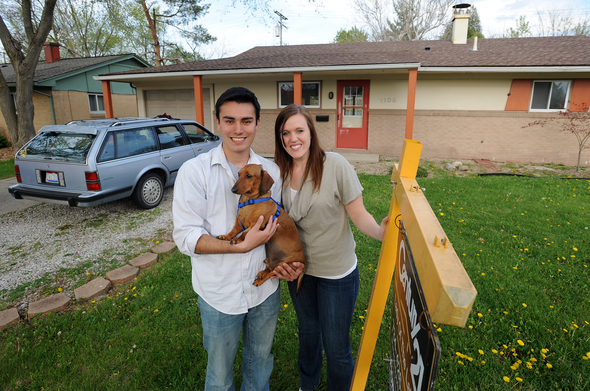
Takashi Gould and Haley Gire pose with their dog Rookie in front of their new home on Maple Street in Ann Arbor. Gire purchased the home as a foreclosure.
Melanie Maxwell I AnnArbor.com
Haley Gire knew she’d buy a house in Ann Arbor since 2011, when she started researching the market and figuring out what she’d get for her $125,000 budget.
By the end of last month her trek had ended when she became a homebuyer, making an offer on March 30 on one of six houses that she visited with her real estate agent.
Of the six houses - seven if you count the one they only viewed from outside - she and her boyfriend, Takashi Gould, liked two of them.
“But one was perfect,” she said of the home on North Maple that will become her first house when she closes the deal in May.
Gire is among the people who are shaping the local residential real estate market for 2012, at a time when sellers are hoping for continued price escalation, buyers are saying there isn’t enough on the market and industry experts say the rebound should - emphasis on the conditional - kick into gear.
Among eight markets tracked in Washtenaw County, four now fit the real estate industry’s definition of a “seller’s market”: Ann Arbor, Ypsilanti, the Lincoln school district and Milan.
But even within those markets there are price points that are slower to sell than the more active categories, showing how the circumstance of one house - with its price, likelihood of selling and how much value it’s lost since 2005 - can be vastly different from another in the same area.
So far this year, based on first quarter numbers reported to the Ann Arbor Area Board of Realtors, many in the industry expect a better year than 2011: Low interest rates, pent up housing demand and inventory shortages are fueling activity that, in turn, is at least stabilizing many prices if not increasing them, experts said.
“The market is firming up on prices,” said Elizabeth Brien, agent at the Charles Reinhart Co. “(What will happen next year) is hard to say.”
Price increases are registering in much of Ann Arbor, which showed a 3.57 percent increase in the sales price per square foot in 2011. That’s one of five communities that showed an increase in 2011, but overall values remain less than 2006, when the market - and the national economy - started to change.
Many buyers “have been waiting to see where is the bottom of the market,” Brien said.
Data reported to the Ann Arbor Area Board of Realtors through the end of March on average shows a local first quarter real estate market that’s largely unchanged from 2011:
• Total home sales are down by 2 units to 593.
• Total condo sales are up by 12 units to 137.
• Dollar volume for homes went up from $104.6 million to $106 million.
However, some measures are showing increases:
• The median sales price is $149,000, up from $135,000.
• The average sale price is $178,903, up from $175,872.
But one of the most compelling changes, industry experts say, is the drop of new inventory coming onto the market: By the end of March, 84 fewer homes had been listed in 2012.
That’s a situation that’s pressuring the real estate industry - which is looking for sales gains after the recession - and buyers in the areas with the fewest available homes, prompting intense competition for some houses even as others may languish.
“The market is changing very quickly,” said Matt Dejanovich, an agent at Real Estate One in Ann Arbor. “There’s no question about that.”
Dejanovich said there’s a shortage of “quality” listings, or homes that are move-in ready and priced appropriately.
He said one recent listing in the Arbor Creek subdivision of Pittsfield Township, in the Ann Arbor Public Schools, drew five offers during its first weekend on the market at $339,900.
“That’s an experience that I think every agent may be having at times,” he said. “But it’s certainly not every house that I list that’s experiencing that. I don’t want to overstate … the market. I have other houses that are pretty night and haven’t sold yet.”
Yet a year ago, Dejanovich said, that same house would have been priced at 7-8 percent lower, and it likely wouldn’t have had the volume or pace of sales activity.
The price ranges in Ann Arbor at the end of March that could be called a seller’s market based on the sales pace and available inventory were homes prices under $450,000 and those priced from $601,000 to $750,000, according to data from Reinhart.
That reflects 323 active listings in the Ann Arbor public schools, and 954 sales in the last 12 months.
The most active price range? It’s from $150,000 to $200,000 - or the more affordable end of housing. Yet just one-tenth of a percentage point from that is the $351,000 to $400,000 price range - a price point that Realtors say likely points to pent-up demand for “move-up” housing and an indicator of return to market normalcy.
In Gire’s price range, 2.6 months of inventory existed at the end of March.
The University of Michigan admissions counselor said she didn’t feel pressure to make a quick decision as she worked with Realtor Shari Mueller of Reinhart. However, the number of homes on the market in her price range that needed extensive work made her realize that her pick - a foreclosure that she described as essentially move-in ready - was the right one immediately.
And a previous experience, when she was discouraged from making an offer because negotiations already were well under way with another buyer, made her realize that “we at least wanted to get an offer in if we liked it.”
In her price range, “there were a lot of houses that needed some love to them, or some foundation work,” she said. “If you’re willing to do that, (the price was worth it).”
The Ann Arbor market has the most sales of any area in the county, so its changes drive much of the market. Yet based on listings and sales totals, some areas are still struggling: Saline is at an average 8.3 months inventory and Chelsea is at 9 percent, while Dexter is on the verge of the “sellers market” threshold at 6.8 months and Manchester is at 7.3 months.
Continued concerns in the real estate market include foreclosures and appraisals. Lenders face much stricter regulations, leaving deals facing much more scrutiny and also vulnerable to appraisals that may not have caught up with the price of the deal.
Repossessions still affect the market, too: Michigan ranks 8th nationally in the number of foreclosures, but the number fell from February, according to Realttrac. Locally, the number of sheriff’s deed sales has fallen this year, while the number of delinquent mortgages in the U.S. is falling, giving some hope that the wave of foreclosures is waning.
Even the number of listings seems to point to the large loss of value recorded, on average, in Michigan’s real estate, said Edward Surovell of Edward Surovell Realtors.
“Many people don’t have enough equity to make a meaningful trade-up,” he said. “And there’s not a whole lot of corporate moving around.”
What he’s seeing is “many people may be feeling that now that the market is beginning to change that it may be better to wait a while (to sell),” he said.
The shortage of listings in Ann Arbor isn’t unique to this community, he added. University towns across the U.S. are finding that core areas have fewer listings than normally found in a balanced housing market.
“Once people realize that prices are going up, it may induce more people to put their houses on the market, but that hasn’t happened yet,” Surovell said.
On the business side, Realtors are encouraging clients to list their homes, but also to make the kind of improvements that with make them fast sales. All year, they’ve said, they’ve waited for a surge of listings that, they say, could slow the price gains in solid markets and stall the potential of appreciation in slower ones.
By the second quarter, the pace of listings - and price changes - should be clearer, said David Lutton, president of Reinhart.
By June, he said, he believes the strength found in today’s market will be more widely perceived, especially if unemployment rates stay under 6 percent in the county.
“If you’re not in the market today, you’re oblivious to these changes,” he said. “… But now all the forces are in place to see prices move higher.
“We’re probably at the threshold of two to three years of improvement.”
Comments
say it plain
Mon, Apr 23, 2012 : 4:19 p.m.
Will there be a "follow up" on the real estate beat about how the just-announced sale of Thompson-Reuters health division and the possible loss (we can only hope the jobs stay even if the profits travel away) of 800 or more jobs in town might "cool down" the market ? Darn it, and the "experts" just announced that the recovery had started!
say it plain
Mon, Apr 23, 2012 : 2:31 p.m.
And gee, I just noticed the details of this bit from here: "...when she was discouraged from making an offer because negotiations already were well under way with another buyer.." What does that even mean!? Did her realtor tell her that the house was under contract or not? What does "negotiations well under way" mean precisely? Unless an offer has been accepted, shouldn't her realtor make an offer for her? Is that acceptable to the local Real Estate Board!?
say it plain
Mon, Apr 23, 2012 : 1:55 p.m.
I saw the print edition of this story this morning and wow, it's even more misleading and attempting to create a sense of urgency than this 'net version! Headline with stuff like "Prices Up" and "Experts say the market is recovered" lol... The story here includes a slight bit more hedging even from the "experts" than that headline implies... It's depressing to me to see young people feeling any sense of urgency right now, and sort of disgusting to me to see the real estate forces playing these games again...but not surprising. It's especially disturbing given that the very lack of a market and all the folks who are underwater on homes they probably didn't expect to keep long (get in, get out, take your profits...as the realtors around here were touting quite blatantly as a source of 'income'), plus the fact that many of the foreclosed-on homes had been held up from market by delays in their processing (and part of *that* was due to the massive numbers!) is part of what they are using to *create* the sense of urgency! This profile is a great example of that! Oh, says this young couple, we wanted a house, saw that we didn't have that much to choose from right now that was decent, and we had an 'experience' where we wanted something but were told there was gasp! another buyer already, So we decided we had to 'at least make an offer if we liked something'. wow. That's the kind of pressure that people seemed to feel *back in the bubble days*, and I find it truly irresponsible of the real estate folks around here to continue playing that game, especially now that they must know in their guts that once you buy something you'd better be prepared to keep it a looong while!
say it plain
Mon, Apr 23, 2012 : 2:47 p.m.
The freedom, by the way, to make mistakes... I believe, is what Realtors advertise they will help you avoid lol! But in any case, yes, I think our 'freedoms' also include to freedom to call b.s. on the 'experts', don't they?! And to hope out loud that people don't fall for the same games time after time after time?
say it plain
Mon, Apr 23, 2012 : 2:43 p.m.
No, that's exactly right @djacks24, it's a free country, and people need to stay educated! Yes, it's exactly the same kind of pressure that people might feel to buy a car from a car dealer who really really really wants them to "go home with a vehicle today" ;-) Or to buy the latest hot toy for their kids for christmas before the store runs out, hurry! It's just that with Real Estate, the transactions costs are even higher, and the press is allegedly offering information rather than advertisements/marketing pieces! Also, it's a very complicated process for most people, and their agents are claiming to be their advocates, when in many cases they don't actually act as such. Plus, when you end up with a house that ends up being wrong for you, or you overpay, the impact on your life can be far far more significant than being out the cash for the toys that turned out to go on sale just a week later with no supply problems....
djacks24
Mon, Apr 23, 2012 : 2:35 p.m.
"That's the kind of pressure that people seemed to feel *back in the bubble days*, and I find it truly irresponsible of the real estate folks around here to continue playing that game," So that doesn't happen say when you buy a car, a piece of furniture, an appliance? You seem just just want to single out the real estate market. My experience with a lot of real estate folks on Trulia is most are concerned about giving customers a great buying experience and quite frankly are not out for a quick buck. Furthermore, this is a free country, with free information at our fingertips. That means freedom to research, choose, and freedom to make mistakes.
mun
Mon, Apr 23, 2012 : 2:57 a.m.
"But one of the most compelling changes, industry experts say, is the drop of new inventory coming onto the market: By the end of March, 84 fewer homes had been listed in 2012." I wonder how much of this is due to homeowners taking their properties off the market because they cannot find any buyers?
say it plain
Mon, Apr 23, 2012 : 4:12 a.m.
Yes, and putting them up for rent in some cases, if the owners have left town. I think a previous article sort of hinted that this might be the case...perhaps it was omitted here because with the 'season' there's more reason to highlight urgency factors...snap 'em up kids, they're not too many now! That seems to be the current 'angle'...
Stuart Brown
Mon, Apr 23, 2012 : 1:10 a.m.
There is a reason Real Estate agents are held in as much esteem as used car salespeople; because the industry never foresaw the Real Estate Bubble much less the bursting of it. I keep reading reports about how the banking industry is gearing up to dump a lot of the shadow inventory that has accumulated in the system and been kept off the market. With the robo signing deal done, there should be a flood of foreclosed properties hitting the market in the next few years.
say it plain
Sun, Apr 22, 2012 : 8:41 p.m.
Wow, and looking at the records for this place is so fascinating... It was sold around with a little appreciation here and there as we moved from 1989 to the early 90s (houses on busy streets sometimes turn around quickly) with a sale price of $82K by 1994. Then, in 2003, it was recorded as a sale for ...omg... $175K! Wow! Did it sprout new square footage?! Did it get extensively extensively remodeled? Can't tell, but wow. I'd imagine a lot of that 'appreciation' had to do with the bubbly advice of realtors, telling the poor sucker buyers that "houses never go down in value" and the poor folks were probably doing all that reading about how they'd better buy now at any price to "get a foot in the market", and no worries about price or value, all is well! They probably felt lucky to get the house for under 200K, because there used to be article after article about how short the supply of <200K homes there were in town! No matter that it was on a busy street, or had minimal 'curb appeal'. So, then it looks like a sheriff's deed for 128K, and fannie mae took it then... I hope the young couple here didn't spend more than about 95K for it, about what it might have sold for in 1996, which, frankly feels a little high for back then, but maybe it's in great shape inside.. Oh lord, though, the SF is only 975 and the assessor's data has it with *no basement*?! Then I truly hope they didn't pay anywhere near 100K for it, if it really is over crawlspace, yikes!
say it plain
Mon, Apr 23, 2012 : 12:14 a.m.
Well @djacks24, I don't think you can argue that banks are expecting ROI so much as trying to avoid more defaults, so as long as there isn't too much ridiculousness in a price, and the credit is decent and downpayment is present and all, I'm sure they'd generally like to help fannie mae out and sell one of the homes on their logbooks! Looking for ROI is generally what got us into this mess, so it's an interesting choice of words on your part. When houses were affordable and we didn't play along like people should be buying houses right out of college with their first jobs or else they were being somehow irresponsible, "return on investment" wasn't really part of the equation.
say it plain
Mon, Apr 23, 2012 : 12:06 a.m.
Oh, forgive me, I thought that this was supposed to be about real estate markets. I didn't make any presumptions at all about their needs or their desires. I merely hoped that they didn't overpay, as so many did when the rhetoric from the realtors around here was all about how "things are moving up". I even mentioned that I had no idea what the house was like inside, perhaps it had been extensively renovated and was "worth" even the 175K paid for it in 2003. Of course home prices and what someone feels is the "value" of a house to them at any given moment is a personal matter. But it is a matter of public record--and also a history and relative judgments about worth that the professional realtors are supposed to make available to buyers but so often do not, especially around here it seems to me--what prices people paid for houses. This article was clearly an attempt to put a human face and a feel-good front to some "look! things are looking up!" stats from the real estate market people in the area, the boosters. Do I hope this works out for these folks? Sure! I am merely offering my opinions along with a little data on how the housing market has gone in this town, and marveling at even those prices for homes with no basements on busy streets. I hate to see other people feel like oh, jeez, we'd better buy a house in Ann Arbor now if we really really want one, because see?! Prices are going up according to the AA.com, and people are having to deal with small inventories and interest rates are going up and on and on with the fear-mongering. And I really *had* driven by that house, saw the sold sign, and said to myself, boy, will the RE folks in Ann Arbor be hugely psyched that *this* thing finally sold, woohoo! And lo and behold lol, here it is in a feature about the improving market!
djacks24
Sun, Apr 22, 2012 : 11:59 p.m.
Furthermore, based on what I know of the market these days and assuming they borrowed for a mortgage, appraisers are being extremely conservative with home values and banks are only lending based upon houses being appraised for at least the asking price. I'm sure many other variables by professionals were taken into consideration. Banks certainly aren't lending if they don't see a return on investment these days, because they are the ones funding this purchase with their money initially and not you. So several units of the housing market came together in a market on life support and decided without your "professional" input that this was a wise investment.
djacks24
Sun, Apr 22, 2012 : 11:45 p.m.
Who are you to access what their needs are or determine what a fair market price for this home is? You don't know these people or their motives. Maybe its the perfect home for them to live in forever or maybe they think they they can sell for profit after a short period of time..who knows? Certainly not you or I. Whatever their motives or whatever the market, a lot of a homes true value is determined more by the buyer than the market. Just because you wouldn't buy the house for what they paid (based on public data found on the net, without actually walking through the house) gives you NO RIGHT to publicly presume in this comments section for all to see they made a bad decision. Furthermore, this is their first home, and first homes can be learning experiences and that is their experience to learn living in a free country. But based on what I see, they made a reasonable choice based on their income and needs which is more than what many folks did that got us into this mess in the first place by choosing to be house poor in an inflated market or using their over inflated homes as ATMs. This is clearly not the case, so keep your presumptions to yourself.
Chase Ingersoll
Sun, Apr 22, 2012 : 4:40 p.m.
All: New buyer, same story every year - "....the market is up and there has never been a better time to buy a home..." Meanwhile the people who bought homes on such information in past years, are kicking themselves. Chase Ingersoll
say it plain
Sun, Apr 22, 2012 : 4:03 p.m.
Wow, when I saw the "sold" sign on that house I was amazed lol...now I know who bought it! Please people, be very very very wary of these real estate cheerleaders! Did they give you actual comps as they are supposed to do, so you can see prices on houses that are comparable instead of spouting these endlessly repeated "improvement" figures?! Make sure you don't spend a penny more than you can truly afford, and please don't buy their "tax advantage" stories and all the rest, and their old stand-by of generating fears that interest rates will rise so you'd better actnow actnow actnow! Do your own research, because the real estate folks around here are very very willing to play fast and loose...most were touting the need to get in the market even when it was already a year or so into the downturn! Their bottom line is *their* bottom line, not yours, so play accordingly! And also keep in mind that the "news" outlets around here used to depend bigtime on RE for their revenue (recall the days when folks spent their weekends with the open house listings?! subscribed to the fishwrap just for those sections?!), and old habits are hard to break! As I recall they were touting the recovery about a dozen times while the downturn had yet to materialize in force yet.
say it plain
Sun, Apr 22, 2012 : 7:20 p.m.
what, @a2roots, it didn't "make sense" before, when it was about how demand can be artificially created lol? I take it you were hoping to hear some insider market wisdom or something? here's a tip then... my sources have it that you shouldn't buy until prices are about where they were at 1996. If a house is selling for more than it would have then, you'd better be careful! And I should have been more conservative in my advice about years-in-a-house, given that many many homes and condos in this market are *not* where they were price-wise back around 1996, but still over-priced given historical averages relative to actual economic conditions. Yes, location is still going to be relevant, as will supply and demand... But demand (via playing headgames about interest rates, local economies, etc) is clearly manipulable...
a2roots
Sun, Apr 22, 2012 : 5:57 p.m.
@sip...now your response makes sense but it is right out of the book. Still is and always will be a game of location, location, location, supply and demand and confidence in the local economy(your job).
say it plain
Sun, Apr 22, 2012 : 5:37 p.m.
ooh, @a2roots, I don't see where you come off believing I know "very little" about it, but, whatever. It's not mudslinging, it's obvious. Be very very careful about salespeople in this line of work...their record is clear, isn't it?! The time to buy a house is when you are planning on staying for a while (at least 5 to 7 years ), when you have a stable source of income and have come up with a good-sized downpayment and have money in the bank as a cushion against losses, and when it makes sense versus renting. The story the Realtors used to push about tax advantages bears looking into, because for many it *isn't* a tax advantage! The story they used to tell about "we expect increases in value over the next years" should be totally debunked by now lol, but irrational hope of getting something for nothing springs eternal! Buy only if you can stand the idea of selling at no profit at all, possibly loss, because clearly it can happen. You should buy a house AS A PLACE TO LIVE, not expecting to turn around and sell it at profit. Interest rates aren't really relevant, that's like buying a car on the 'monthly payments' , no? Some people do it, but generally only the least sophisticated buyers. It was a big part of how artificial price increases were worked into the bubble market, with exotic mortgage products and all. Sure, it can have some small effect on exactly when you'd want to buy, but price is most important. I used to love to watch this market back when everyone would wet their pants about interest rates dipping yet farther, wow, now they are at under 7.5, now under 7, how low can they go, and all... The asking prices would be almost universally raised by the realtors in town, to reflect the new "buying power" lol. Refi and "cash out equity" defined our economy, and it was a false one, as you may have noticed recently...
a2roots
Sun, Apr 22, 2012 : 5:22 p.m.
@sip...So if you are so smart when is it a good time to buy? How low do interest rates need to go? There are unsavory characters in all professions but for some reason the real estate arena (realtors, bankers, appraisers, et al) are all crooks in your eyes. Can only imagine what you think of your competitors in your line of work. I would suggest you quit slinging mud at an industry that you appear to know very little about.
say it plain
Sun, Apr 22, 2012 : 5:05 p.m.
Unfortunately for many, Realtors, mortgage brokers, and the Press did a *lot* to "make the market" during the bubble run-up! They did just as you are doing with this post... They used stats to manipulate emotions, they made people feel as though they'd be stupid not to buy buy buy (see for a more modern example the quote from the Reinhart guy about how "you'd be oblivious" if you weren't in the market now lol), they played fear games with "interest rates are so low...you 'd better buy now before they go up!", they selectively informed (a nice way to phrase it!), and they didn't do their due diligence in many many instances in terms of offering real comparables. Appraisers also were "making markets" by having special relationships with banks, and all manner of shady and collusive arrangements that helped cause a bubble as big as the one we've had in this nation.
John Tenza
Sun, Apr 22, 2012 : 4:51 p.m.
A good real estate agent will always be aware of what the market is... and willing to share the facts of record. In today's market, appraisers, lenders and underwriters all play a role in a successful closing on a home. So let's be happy that after 5 tough years, homeowners can sell for more money, buyers have super low interest rates and things are picking up. Real estate agents do not make the market... they just work in the market.
Royalprince
Sun, Apr 22, 2012 : 4 p.m.
I hope that the housing market gets better and quickly, because all I ever read about in the business section of many national newspapers I read, is that the foreclosed properties are still a real drag on people who want to sell. Our home in Pittsfield was valued at almost $200,000 back in 2006, but now the township listed it at $158,600 this year. That really sucks! I never imagined when we first bought our home back in 1996, that the housing market could go into the abyss like this!
say it plain
Sun, Apr 22, 2012 : 5:24 p.m.
It was artificially inflated beyond the abilities of most people to pay for housing... a giant debt-fueled pyramid scheme that depended on lots of players to work, but it was for many years clearly a house of cards ready to fall... People can't keep spending higher and higher and higher percentage of their income on housing costs with no raises or jobs for the next holders of the hot-potato houses that kept going up in value for no reason...
Dog Guy
Sun, Apr 22, 2012 : 1:36 p.m.
When happy days are here again it will be due to the optimism and hard work of youth, exemplified by Gould and Gire. I hope they invite us all to the wedding.
Kristine
Sun, Apr 22, 2012 : 8:25 p.m.
Wish I could "vote up" twice for your comment. :)
Nicklas
Sun, Apr 22, 2012 : 1 p.m.
Very good article and let's hope the recovery we're in is real. 1 thing to keep in mind though, as a financial counselor, one of the biggest disconnects I see in my clients is not understanding there can be a difference in the appraised value of their home and the market value of it. And at the end of the day, what matters is the market value. The following example illustrates my point: http://onthefrontlinesofamericanswarwithdebt.wordpress.com/
A2Boiler
Sun, Apr 22, 2012 : 1:13 p.m.
In most cases, if the house doesn't appraise for what the market will pay for it, then the bank won't grant a mortgage. Low appraisals are a HUGE issue with BOA, Chase and the big banks - recommend that people work with local lenders who are more responsive and provide realistic appraisals.
Wolf's Bane
Sun, Apr 22, 2012 : 12:23 p.m.
This home was featured on the House Hunter cable show a way back. T'is a good home.
say it plain
Mon, Apr 23, 2012 : 2:51 p.m.
Mine? In saying that the whole cable tellie obsession with house flipping, hunting, buying and selling was part of why the market was so bubbly back then? Clear, I think. Does this house, since you seem to be 'making the point' that it is a 'good' home, really not have a basement?! You do realize that homes nearby with full basements under the same or more SF are going for the same prices, and are off the main noisy dragway? I missed the episode, so I don't know what warrants that price for it! Granite countertops maybe?
Wolf's Bane
Mon, Apr 23, 2012 : 11:52 a.m.
And your point is..?
say it plain
Mon, Apr 23, 2012 : 4:06 a.m.
'Kay, great @Jojo B, then it is a different sort of beast than what used to be on house-related cable, good to hear it!
Jojo B
Mon, Apr 23, 2012 : 2:51 a.m.
@say it plain: House Hunters is a reasonable show about people like you and me who are looking to buy a house and check out three and share their decision-making process. It is NOT about flipping or getting a smart ARM mortgage or any other real estate bubble evil you have in mind. It is actually a useful show for people to watch if they are in the market as it helps people see and think about what's important in a purchase. Please don't demonize it.
say it plain
Sun, Apr 22, 2012 : 5:17 p.m.
oh lord, cable shows dedicated to house buying and selling lol... *that* was another fun aspect of the bubble and I guess of the bust too!? I tend to feel there are better ways to spend one's time, but shows about flipping real estate were really wonderful for "making markets" back in the day as well!
Evergreen
Sun, Apr 22, 2012 : 12:08 p.m.
The biggest issue I've seen is the lenders not lending to stable buyers. The same banks that we bailed out a few years back, gave bonuses, went to Fla. for executive meetings, and didn't loan buyers who would have been a quick qualifier in 2003 and before.
say it plain
Sun, Apr 22, 2012 : 5:15 p.m.
Maybe they're not so sure that there won't be further downside?! Just a thought :-)
a2roots
Sun, Apr 22, 2012 : 5:06 p.m.
@evergreen...sorry to say but you are wrong on many counts here. Rules changed which brought forth a few more hoops that had not been present for quite a few years but qualified borrowers were able to borrow. Those quick qualifiers you refer to are the ones that essentially crippled the economy because they were the first to bail on making their payments when the market tumbled.