

Officials: University Research Corridor has $15.2 billion net economic impact on Michigan's economy
Local leaders and business developers met Monday at the ex- Pfizer location in Ann Arbor to discuss how Michigan's University Research Corridor, which the University of Michigan is a part of, has become an “economic engine” and a nationally recognized hub for research generated technology and small business development.
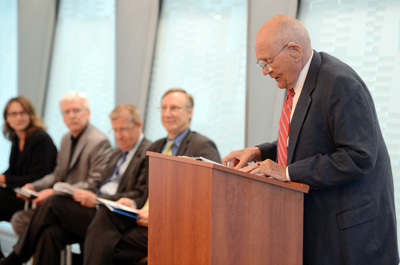
Rep. John Dingell addresses a small group during a news conference at North Campus Research Complex on Monday afternoon.
Melanie Maxwell I AnnArbor.com
The institutions formed the URC to leverage their collective assets, encourage collaboration, and increase business partnerships, with the goal of accelerating statewide economic development.
According to a recent benchmarking report, the URC ranked fourth in U.S. patents granted, and fifth in invention disclosures, licenses and options granted, and licensing revenue -- which totaled $37 million -- when comparing its 2006-2010 average annual technology transfer activities with its peer university clusters. The URC is tied for fifth in number of start-ups it has helped to create.
Vice President for Research Stephen Forrest said he believes the university is on the "edge of an explosion in innovation."
"This explosion will drive the revitalization of the country and I think it will have ripple effects across the entire Great Lakes region and really the entire nation," Forrest said.
URC Executive Director Jeff Mason said that between the three institutions that make up the URC, on average they have produced one new company every month for the past five years.
"That is an indication of not only the innovation going on but the success that is coming out of these institutions," Mason said.
Kenneth Nisbet, executive director of U-M Tech Transfer, said that Michigan universities are contributing to the economy as never before. URC institutions conferred 18,277 high-tech and high-demand degrees which was more than any other university cluster except for Pennsylvania.
"Our researchers submit over 350 ideas a year or at the rate of one per day," Nisbet said. "We have launched more than 92 startups over the past 10 years for the average of one every five weeks."
Currently, the University of Michigan's Venture Accelerator, which is a place that provides state of the art labs, equipments and office spaces for new companies, has 17 tenants. The business incubator is located in the16,000-square-foot former Pfizer site in northern Ann Arbor. The university bought the building for $108 million in June 2009.
"It was launched in January of last year and the accelerator company is far ahead of schedule," Forrest said. "We already have a company that is about to graduate and open a space for the next in line."
In total, the start ups and those that have spun out have created more than 1,800 and counting, Nisbet said.
"It takes a while because when they start it is often with just a few people and they end up growing,' Nisbet said. "By planting roots here, they have the capacity to grow a lot and stay here in Michigan. We're close to capacity and we're amazed."
Nisbet said most of the start up companies have stayed in Washtenaw County but a few have located elsewhere such as Fusion Coolant which is now headquartered in downtown Detroit.
"They typically like to stay in the county because that's where the talent is but some have relocated," he said.
Nisbet said he believes the startups will contribute to job creation to the local area and on a state level as well.
"When these companies grow, they have suppliers and they look for talent so they're developing talent for the entire region and the entire state."
Forrest said the university has plans to work with Ann Arbor Spark to drive even more economic growth to the region.
"We're working to find new ways to bring the private sector here and to merge our efforts with them so that we can start an industrial park here in Ann Arbor that will be mostly based on technology," Forrest said. "Michigan has gained the recognition it deserves as a hot bed for technology."
3D BioMatrix CEO Laura Schrader said her company is growing at a fast rate. The company is one of the seventeen startups and specializes in selling 3-dimensional cell culture products for the drug discovery and testing market.
"We're a company that is growing," she said. "We're making sales and we have revenue now. We're selling from Korea to the U.K. to the United States to South America. We have distributors around the world."
Schrader said she has a staff of three full-time employees, two contractors and one summer intern. Schrader plans to hire more in the next six to nine months.
"For a small company, I think we have a pretty big impact on the area," she said. "People should believe that the process is working. We must encourage talent to stay here and grow here."
Comments
Veracity
Wed, May 23, 2012 : 3:52 a.m.
The article is in error: the University of Michigan paid $108 million for 2 million square feet in the Pfizer complex of buildings on Plymouth Road, not just 16,000 square feet as stated. http://www.annarbor.com/business-review/300-university-of-michigan-employees-will-move-into-ex-pfizer-site/
Joel A. Levitt
Tue, May 22, 2012 : 1:09 p.m.
Wonderful!
dotdash
Tue, May 22, 2012 : 12:33 p.m.
This URC is an interesting idea, but really, how much do the three institutions have to do with each other? This seems like a conglomeration made for some political purpose -- like seeming bigger, defending the tax-free status of the ex-Pfizer incubator and/or providing political cover for tuition increases -- rather than an organic unit.
trespass
Tue, May 22, 2012 : 11:42 a.m.
"URC institutions conferred 18,277 high-tech and high-demand degrees". How many of those degrees went to American citizens? Nationally, 47% of all PhDs in engineering have been granted to foreign citizens. It is even higher at UM. Let's educate Michigan students first and then we can have more economic impact. www.professorkauffmanforregent.com
beardown
Wed, Jan 23, 2013 : 9:52 p.m.
trespass, your information is a couple years old. GE and other companies are moving jobs back here. Not because of our brilliant minds, but because running a company across a couple oceans is proving to not be as cheap as they thought and because it is good PR. Even the foreign companies are moving their production to the states in order to save money. Most "foreign" cars are made in the US now, not because of our great craftsmanship or wonderful workers, but because it is cheaper to build them here (as long as the unions stay out of the picture). And wrong about the moving of jobs to China. http://www.economist.com/news/special-report/21569570-growing-number-american-companies-are-moving-their-manufacturing-back-united?zid=306&ah=1b164dbd43b0cb27ba0d4c3b12a5e227
trespass
Tue, May 22, 2012 : 11:28 p.m.
Actually, it may have been true at one time that most foreign students stayed in the US but with most of them being from China and the Chinese economy booming it is no longer true. It is also not true that engineers cannot find jobs. American companies like GE are moving key divisions to China because they say they cannot find enough engineers in America. Governor Snyder has been in Washington DC lobbying for an expansion of the EB5 visa program to get more Chinese immigration and investment in Michigan.
Thaddeus
Tue, May 22, 2012 : 3:51 p.m.
And why would we want to educate more PhDs, Masters, or even Bachelor Degree holders (particularly if at tax payer expense) when there aren't jobs for the countless 1,000,000s of Americans who already have the degrees and experience....? Regardless of where these students are from.
dotdash
Tue, May 22, 2012 : 12:30 p.m.
Generally, I think the foreign students who get PhDs here try to stay and work here, so where's the problem? It's not as if we are educating students who then go back home. In fact, we are benefiting from the education those foreign countries gave to those students for 12-16 years before they got here, not the other way around. Everyone would love to have more Michigan students get PhDs -- but they have to apply first.