

DTE Energy presses ahead with smart meters as state investigation continues
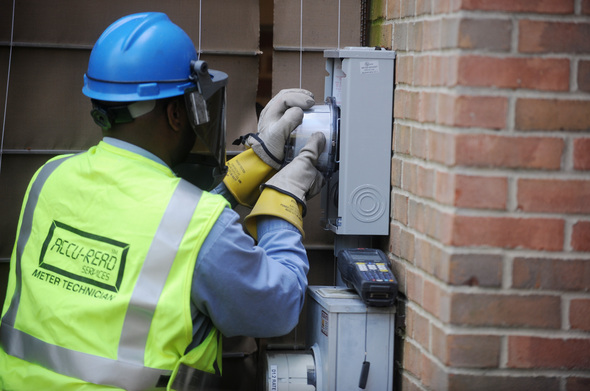
Technician Garron Jackson installs a new DTE Energy smart meter at the home of an Ann Arbor resident.
Melanie Maxwell I AnnArbor.com
(Related story: Smart meter installation: What Washtenaw County residents need to know)
DTE Energy’s decision to install advanced electric meters at nearly every Washtenaw County home comes as the Michigan Public Service Commission continues its statewide investigation into the health and cost implications of the devices.
The so-called “smart” meters — which wirelessly distribute information about electricity consumption — allow the Detroit-based utility to remotely monitor power outages and allow customers to track their usage.
DTE in February launched a plan to install smart meters at 120,000 homes throughout the county, including Ann Arbor, Saline, Ypsilanti, Chelsea, Dexter and the townships. Washtenaw County has about 134,161 households, according to recent U.S. Census data.
“These meters have the ability to tell us when they’ve lost power as well as when the power’s been restored,” said Bob Sitkauskas, manager of the advanced metering infrastructure project for DTE. He said the meters, which capture usage data digitally, would expedite the process of power restoration after storms.
The meters also give consumers the ability — through a free online account — to monitor their hour-by-hour electricity usage on the day after the power is used. Smart meter advocates say the devices lower energy usage by providing more information to consumers about their power consumption.
Crews have already started installing the meters at homes in Ann Arbor, Ypsilanti and Ypsilanti Township. DTE is absorbing the cost of installation. Smart meters are being installed on electric meters, while natural gas meters will simply get a “module” that allows wireless data distribution.
The move has dredged up concerns among smart meter skeptics, who have filed a steady stream of complaints with the Michigan Public Service Commission.
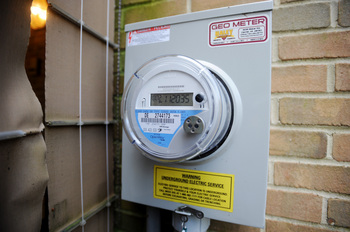
This smart meter was installed at the home of an Ann Arbor resident.
Melanie Maxwell | AnnArbor.com
The commission in January opened an investigation into smart meter installation by regulated utilities throughout Michigan, including DTE, the state's largest electricity provider.
The investigation includes an examination of the safety of smart meters, whether any consumer information will be inappropriately collected and whether the smart meters lead to price increases for consumers.
Judy Palnau, a spokeswoman for the MPSC, said the commission launched the investigation in part “because of the number of inquiries from individuals, plus a number of municipalities throughout Michigan have passed resolutions asking the commission to look into this.”
Among the concerned citizens is Ann Arbor retiree Rebecca Morr, who said in an email that she began to feel “jittery” and experienced “a buzzing vibration in my head” after crews installed a smart meter at her Gloucester Way home on March 10.
“I really am concerned about people who may be more at risk for problems: the elderly, people with prior conditions, people like me who already have sensitivities, and especially for children,” Morr said in the email.
DTE's Detroit Edison unit, working with a contractor, is installing meters manufactured by Liberty Lake, Wash.-based Itron Inc., which filed a report March 16 with the Michigan Public Service Commission concluding that the meters generate an "extremely low level" of radiofrequency emissions compared to legal limits.
The report, compiled by Itron product line manager Mike Belanger, uses a formula sanctioned by the Federal Communications Commission to conclude that the smart meters produce radiofrequency emissions ranging up to 0.833 percent of the FCC limit.
A report released in February by the Vermont Department of Health based on “actual measurements at active smart meters” found that the devices “emit no more than a small fraction of the (RF) emitted from a wireless phone, even at very close proximity to the meter.”
Sitkauskas said smart meters are no different than other common digital devices that transmit radiofrequencies.
“RF waves are around us every day,” he said. “You’ve got remote-controlled TVs, garage door openers, baby phones, cell phones, cordless phones. All those entities have a level of RF.”
Morr, recounting her experience after her smart meter was installed, said she began to feel strange sensations after walking to her kitchen sink, which shares a wall with the smart meter on the outside.
Morr said that, as a practitioner of Bikram Yoga, she was checking her blood pressure that day. She said it spiked from 118/72 before the installation to 165/89 afterward, leading her to contact DTE to request the removal of her smart meter.
DTE, in its March 16 message to the MPSC, said that it plans to develop a program allowing customers to opt out of having a smart meter.
But the utility warned that it would seek to charge additional fees to customers who opt out to support the cost of a meter reader and other costs associated with maintaining an analog reader.
DTE meter readers, who are contracted employees, will be gradually phased out as the utility continues to install smart meters throughout the state. DTE said more than 1 million of its customers would have smart meters by the end of 2013.
“The readers themselves - they attrition out about one-third per year because it’s an entry-level job and the guys move on,” Sitkauskas said. “We don’t anticipate any layoffs.”
Meanwhile, MPSC is also investigating electricity costs associated with remote reading by smart meters. Some consumers in California, in particular, have accused utilities of raising rates through the installation of smart meters.
Sitkauskas said the meters are 99.7 percent accurate in the most extreme conditions. He said once customers have access to hour-by-hour information regarding their power usage, they’re often confused when they realize that they’re still using meaningful amounts of electricity even when they’re not home or sleeping.
“We will work with the customer if they have any issues to try to make sure there’s nothing there,” Sitkauskas said. “A lot of it is phantom power. If you look in your room and you see all these green lights from your PCs and TVs, they’re all drawing power.”
While the smart meter installation continues, the Michigan Public Service Commission is compiling information about the impact of the devices. The deadline for comments from the public is 5 p.m. April 16. Commission staff members plan to develop any appropriate recommendations by June 29. After that, commission members will decide whether to take any action.
Contact AnnArbor.com's Nathan Bomey at (734) 623-2587 or nathanbomey@annarbor.com. You can also follow him on Twitter or subscribe to AnnArbor.com's newsletters.
Comments
Doc2rDayv
Thu, Dec 6, 2012 : 3:45 a.m.
Well, my new meter was installed 3 weeks ago and my new DTE electric bill is 3x last November's bill electric usage (in KWH) and 2x the highest bill I have ever had! So, glad that a lot of you are happy about the change, but someone's getting rich off this and I'm hoping it is a huge mistake or I am going off the grid for good. At this price, I couldn't afford to pay my bill anyway!
Thomas Kabisch
Wed, Apr 4, 2012 : 4:47 p.m.
autism is 1 out of 55 now up from 1 out of 1500, RF, EMF, Microwave increasing without end ?
Thomas Kabisch
Wed, Apr 4, 2012 : 4:45 p.m.
you better educate yourself u tube 'smart meters the dark side
Joe_Citizen
Mon, Apr 2, 2012 : 9:55 p.m.
Every single person I know who has one of these, including myself, has experienced much higher bills. Some actually doubled. Why is this, it's because the electric company uses our electricity to run the Smart Meter. I have also read reports that claim they put out much more Rf's then they claim. So who is right here? I say no to the Smart Meter until the Michigan Public Service Commission, comes out with their findings. I really don't want one, and I believe they do more then just measure electric power. I have read many reports and none of them give positive feedback for SM's. Either way, I have big dogs in the back yard guarding my meters while I'm gone. Say No, until theMichigan Public Service Commission, come out with the report.
Joe_Citizen
Mon, Apr 2, 2012 : 9:56 p.m.
I have several houses.
margo
Sun, Mar 25, 2012 : 3:45 p.m.
At the public meeting with MPSC in Nov.2011 this question was ask: How save is thid digital device, What chemical , mineral are in it. How save for the general public? But the answer never came> First at a cost to TAXPYER of $ 84 MILLION Dollars it is an outrage to WASTE Taxpayer Money (so much for washington Cutting the budget).We customer of DTE Save ENERGY ,BUT the savings in form of Money are not gvien to the Customer, check your DTE bill dec. 2011 to dec.2012 I used 90 KWH less but the price stayed the same! Also replacing apples for apples is useless, jobs are lost and no improfment for customers.The $ 84 MILLION should have been uSED for SOLarpanel on Customerhouses and then sold back to DTE. We need sysstem that improvs the Value of Living , not he same system(if not brokedonot fixed IT)Countries world wide have avalue on Living , while here we chase the ALmight dollar , like a dog chases his tail NO RESOULT or any form of better ment for the lving, PS why is the installer in the picture covert -up his face ?
JRW
Sun, Mar 25, 2012 : 1:20 a.m.
I've read many articles on these smart meters, and in states where they are being installed, residents are experiencing much higher bills after the meters are installed. These are creating a lot of controversy, not just the security and health issues being raised, but the much higher electric bills that result after the so-called smart meters are installed. Want to save money on your electric bill? Plan on only using your AC after midnight. Plan on making that Sunday roast in your electric oven starting at 3:00 A.M. And "DTE is absorbing the cost of installation." Right. That's why our rates went up in October 2011 and again as of Jan 1, 2012. After examining my electric bills for the last 3 years, my actual electricity portion is only 33% of the total bill. The rest are surcharges, fees and taxes. We will all pay higher rates, increased surcharges and have higher bills after these smart meters are installed. Google "smart meters" and read about some of the spiking bills after these meters were installed. Good luck talking to DTE about higher bills. My Feb bill listed that I was supposed to get a CIS credit of 0.073 per kWh (193 kWh x 0.073 = $14.09) though it does not appear anywhere on that bill or on the Mar bill. Calling DTE was no help at all. No one can tell me exactly where the credit is in my bill, but they insist that "it's already in there." Funny how my bill is the same as it has been within a couple dollars for the last 12 months, but that $14.00 credit is in there in the Feb bill. Right. Don't believe them. It's all doublespeak. I can't wait to move out of this state next year.
Richard
Fri, Mar 23, 2012 : 11:31 p.m.
Nathan - Why would you quote that poor woman's email? That's just leaving the door wide open for her to be publicly humiliated and goes against the same philosophy that gets comments deleted.
George Peats
Fri, Mar 23, 2012 : 10:47 p.m.
If your worried about your Privacy. Then Cancel your Facebook account .
George Peats
Fri, Mar 23, 2012 : 10:39 p.m.
If it can be turned on By A Remote, Then It Never Shuts off Till you unplug it . If it Has one of those Transformers that plugs into a Socket .. That Transformer Never Turns off .. It is Constantly Creating what is Called EDDY CURRENT . Until u take it out of the Wall Your Door Bell uses a Transformer. Normally you will find it Mounted on the Side of Your FUSE/Breaker Box . Your Cellphone Charger .. Gobble gobble the Electricity . And Then if You Have one on Those RE-VOLT-ing Volts.. That Charger is Eating power when you are Not using it .
u812
Fri, Mar 23, 2012 : 10:39 p.m.
Read a lot about these and expect to pay a higher electric bill in the future.
Don B. Arfkahk
Fri, Mar 23, 2012 : 6:13 p.m.
DTE already reports "suspicious power usage" to the police. This will make it much easier for them to identify such cases. It frequently lead to no knock raids, pets being shot, and kids finding themselves in a foster home with their loving parents gone.
Basic Bob
Fri, Mar 23, 2012 : 7:04 p.m.
Think of it as a low-cost alternative to black helicopters with infrared sensors.
Jaime Magiera
Fri, Mar 23, 2012 : 5:41 p.m.
I understand people's privacy concerns, but if you look at the bigger picture, consumers already trust their cable providers not to abuse channel/movie purchase information, we trust our internet providers not to abuse our traffic information, etc. In other words, we already have trust relationships with businesses that form the foundation of our daily lives. Why would DTE, the provider of our most important household resource, not be viewed in the same light? The use of "intelligent" systems can greatly increase efficiency and accounting -- something very important in terms of energy usage. I agree that any systems should be checked for security holes, bad design, etc. However, that should be applied to all systems, and not be tinged with unnecessary fear and misinformation.
margo
Sun, Mar 25, 2012 : 3:53 p.m.
TRUST : cable . yes every months I call to check on them WHY IS THERE and increase etc etc TRUst it is like ASs-ume.
margo
Sun, Mar 25, 2012 : 3:51 p.m.
TRUST check out wwww.HAARP.com
margo
Sun, Mar 25, 2012 : 3:50 p.m.
TRUST yes DTE got $ 84 MILLION for the TRUST to take more and losse more employees!
Don B. Arfkahk
Fri, Mar 23, 2012 : 4:57 p.m.
One thing I did overlook - with hourly usage reporting, the fine folks at DTE will be able to locate every marijuana grow in their territory. Marijuana growers typically use high wattage lights that run at night (to avoid heat problems, and peak rates). They will run at fixed intervals of 12 hours on, 12 hours off, when they are flowering their crop. This is easy to identify with hourly usage reporting, and will be highly profitable for me when the Michigan Medical Marijuana Act dies a death of a thousand cuts in Lansing, and I am able to sell the labor of cancer patients for 10 cents an hour to Boeing from the comfort of the administrative offices of my newly approved private prisons.
Craig Lounsbury
Fri, Mar 23, 2012 : 6:03 p.m.
Nice try....but when I'm not using my high wattage lights I run electrical cords to my neighbors and sell them discounted electricity. This way I not only mitigate the cost of my lights but I balance out my metered usage. you'll never catch me alive
average joe
Fri, Mar 23, 2012 : 4:55 p.m.
"DTE is absorbing the cost of installation..." Just like they 'absorb' the cost of producing power, they always pass the costs onto the customer. But if it saves them money......
Don B. Arfkahk
Fri, Mar 23, 2012 : 4:44 p.m.
The one disadvantage to variable power rates is that medical marijuana growers can set their timers to run their lights during off-peak hours, and actually lower their bill. I find it unacceptable that drug addicts are not being forced to give me more money for sitting here in this chair and mocking them as I am paid obscenely for my idleness. This is why I support repeal of the Michigan Medical Marijuana Act - I have invested a great deal of venture capital in private prisons that may soon be constructed with the support of some of my legislative buddies in Lansing.
Don B. Arfkahk
Fri, Mar 23, 2012 : 4:39 p.m.
The real question, which was not addressed in the article, is whether these meters also come with variable power rates depending on the time of day, and if so, what these rates will be. Many utilities have installed meters with variable rates and used them to increase customer's bills without approval from regulatory authorities. If this is the case, I strongly support this change - as a major shareholder in DTE, it would make me rich. Profits are higher than ever at DTE, but why not make even more?
margo
Sun, Mar 25, 2012 : 3:54 p.m.
yeah power to you guess what I will crank up my mirrors and cook -up lunch.
Tru2Blu76
Fri, Mar 23, 2012 : 4:25 p.m.
Ann Arbor already has wifi parking meters. Our sinister shadow government uses hidden technologies in them to keep track of us even as we walk down the street. Not mentioned: apartments will each have their own DTE meter / secret spy device, so everyone who has "a roof over their head" will be monitored even as they take showers & baths & indulge in "conjugal activities." Your new electronic refrigerator is reporting your overeating before you even cook your meals! LOL! BTW: power companies are NOT actually "causing" higher electric bills. It's just supply and demand: the supply is mostly from fossil fuel burning and the demand, well, we can't do without heating & cooling & half a ton of electronics now, can we? Our "early summer" will have consequences even if the rest of "real" Spring and Summer are normal. Mean temps for every day in March have been "violated" - often at record levels. So abnormal has this been that statistical analysis shows that this March might occur at our location only once in 4774 years. (Source: Dr. Jeff Masters, Weather Underground) Good luck to us if July & August have the same kind of anomalous temperatures.
JRW
Sun, Mar 25, 2012 : 1:23 a.m.
If people don't use any AC during the early heat wave, then their electric bills should be the same as previously, right? If you turned on your AC, then expect a higher bill. Why does the early warmer weather for 2 weeks have any bearing on electric rates? It only affects electric usage.
Don B. Arfkahk
Sat, Mar 24, 2012 : 4:55 a.m.
DTE has record rates AND record profits.
pseudo
Fri, Mar 23, 2012 : 4:11 p.m.
wow, the commenter's here can be fabulously entertainined. I, for one, am looking forward to mine. I want the data and I want the assurance of properly functioning equipment. DTE is no longer a public utility working in the public interest. We demanded they change to a for-profit hound, sell of the transmission portion of their company and allow "competition" in the market place. These smart meters are not the result. High prices, a useless Public Service Commission are. These smart meters are technically required to improve our grid. So lets take advantage of that and get the data and change our ways!
YpsiVeteran
Fri, Mar 23, 2012 : 3:53 p.m.
Ffej440 is right; DTE does NOTHING simply to "benefit" customers. They are getting the program costs back, from us. The Michigan Public Utility Commission is a pathetic joke. One only has to look at the cost of cable TV in this state to see how good the MPUC is at "regulating" anything. They are as corrupt as just about every other public body in this state, and they operate an unmonitored fiefdom filled with conflicts of interest and back-door deals with the industries they are charged with overseeing. DTE has been allowed to invest ZERO dollars in public infrastructure improvements while reaping billions in profits. They continue to string overhead lines, instead of burying them, in spite of having clear and plentiful right-of-way in which to bury lines, even while being completely unable to maintain a consistent power supply in any type of weather. The power supply in Wayne County is a joke. The power goes out constantly, for no apparent reason. They have no long-term plan to improve the grid, and are now using taxpayer money to install meters with the end goal of charging everyone more money for ever less reliable service. No public utility should be allowed to be for-profit. The models out West are vastly superior to what is done here. Lines are buried, power delivery is incredibly consistent and reliable, and power customers receive checks back from the utility as their "share" of the money left over after the system is maintained and improved. Fifteen years after I left, I'm still receiving a yearly check from the electric company for my "member equity." The few lines that are overhead, such as the ones strung over the Rockies from the foothills west of Denver into the mountain communities, are built and maintained to withstand conditions 100 times worse that anything we ever see here, and yet the power is always on. DTE is the worst kind of predatory monopoly, and until we demand change, they will continue
YpsiVeteran
Fri, Mar 23, 2012 : 4:53 p.m.
Correction, the document was prepared on behalf of MPUC staff, not the commissioners themselves. The result is the same.
YpsiVeteran
Fri, Mar 23, 2012 : 4:50 p.m.
http://efile.mpsc.state.mi.us/efile/docs/15244/0093.pdf
YpsiVeteran
Fri, Mar 23, 2012 : 4:49 p.m.
The Michigan Public Utilities Commission is funded by the utilities it purports to regulate. Read pages 4 and 5 of the below linked document if you have any doubt about the MPUC's attitude toward Edison rate increases. Member stated plainly that, in their minds, utilities are "expected" to recover the costs of funding the MPUC, plus the costs of utilities' "donations" to the MPUC, plus the costs Edison incurs defending rate increase and other proposals in front of the MPUC, from taxpayers.
molly stockwell
Fri, Mar 23, 2012 : 3:07 p.m.
Actually, if you have ever measured the RF on these meters when they pulse or spike, which they do several times in an hour, the radiation is a hundred times more than a wi-fi antenna and over 6 times more than an iPhone. Utility companies use time averaging in their citations which skews the RF numbers and hide the spikes. Experts agree that it is predominantly this spiking that is hurtful to people who are in close range when it happens, i.e. a few feet away.
Jaime Magiera
Fri, Mar 23, 2012 : 5:44 p.m.
I work with Wifi and RF, I've not seen such numbers. Can you provide a reference?
Craig Lounsbury
Fri, Mar 23, 2012 : 4:48 p.m.
ditto what DBH asked. A reference from an unbiased source would be nice.
DBH
Fri, Mar 23, 2012 : 3:41 p.m.
Reference, please, for your statements?
Robert Granville
Fri, Mar 23, 2012 : 3:05 p.m.
Get off my lawn! And while you're at it, stop riding those danged skateboards on the sidewalk!
HeimerBoodle
Fri, Mar 23, 2012 : 3:35 p.m.
Pull up your pants young man, wash that harlot's color off your face young lady. Kids with their hippity hop music and their Tweeter and MyBook! While we are at it, what about fluoridation? You've never seen a DTE Smart Meter drink water!
bunnyabbot
Fri, Mar 23, 2012 : 3:03 p.m.
it's very simple. If you want a smart meter for whatever reason that is fine, but if you don't want one for any reason, whether it is "big brother"/privacy, tech-phobia, buzzing in your head or sensitivity to whatever, consumers should have the right to opt out of having one installed on their home. DTE should not proceed without having in place a program that allows consumers to opt out.
Jaime Magiera
Fri, Mar 23, 2012 : 5:48 p.m.
Sure, but eventually, the technology will be so widely adopted that it will cost too much money to maintain the older system. That's when DTE will provide incentives to get people to update, and eventually it will be mandatory.
Ron Granger
Fri, Mar 23, 2012 : 1:59 p.m.
I visited a home with a smart meter. It gave me a terrible case of the vapors. More seriously, these have tremendous privacy implications. They are being coerced onto customers who do not have a choice. And in terms of benefit, providing customers with their hourly usage data 24 hours LATE is next to useless.
Jaime Magiera
Fri, Mar 23, 2012 : 5:51 p.m.
You trust your cable, phone and internet companies to not abuse usage information they collect. Why is it different for DTE? How is it useless to recognize patterns in your energy usage? It can show you were maybe you're doing too much of one thing and not enough of the other. It can show you where you might be able to save money in the future. I sense you haven't really thought this through.
no flamers!
Fri, Mar 23, 2012 : 1:58 p.m.
Let's just hope the fake complainers that hear "buzzing" in their heads don't delay progress. It continues to amaze me that complaints lacking any basis in science, like RF waves causing headaches, actually get reported in the press.
margo
Sun, Mar 25, 2012 : 4 p.m.
check -out www.HAARP.com
Rugeirn Drienborough
Fri, Mar 23, 2012 : 1:48 p.m.
Like others who have posted here, I'm very much looking forward to the ability to monitor my electricty usage. I'd really like to be able to chase down power drains that aren't doing anything I really need. As for some of the negative reactions, all I can say is, there really are cases where we need to think seriously about how to get people reconnected to reality.
margo
Sun, Mar 25, 2012 : 3:58 p.m.
HOW BIG IS YOUR HOUSE , to save money ..from/in>
Jaime Magiera
Fri, Mar 23, 2012 : 5:53 p.m.
YpsiVeteran, many devices have switches. Perhaps you forgot to switch something off. Also, there is the ability to know when is the right time to use things for efficiencies sake. Also, the smart meters will increase the ability to have an overall smarter power grid (resources being allocated to the places that need them most). I won't bore you with engineering details, but there really is a lot of value to these systems.
YpsiVeteran
Fri, Mar 23, 2012 : 5:13 p.m.
Correction...the first "are" in the first sentence above should be "and."
YpsiVeteran
Fri, Mar 23, 2012 : 5:12 p.m.
I think all these posts from people who think a new meter will somehow enable them to monitor their electricity usage are reduce their bills in ways they are can't now are hilarious. You think you need a "smart" meter to 'chase down' power drains? Here's some advice: If it's plugged in, it's using power. If it's unplugged, it's not. If you want to use less power, unplug stuff. No electricity meter is going to help you save money, unless it's able to come into your home and unplug your stuff.
ffej440
Fri, Mar 23, 2012 : 1:45 p.m.
Once again this story is reported like a DTE ad. The EISA act of 2007 Section 1306 provides matching funds for smart meters.(You and I are paying half the cost in taxes) DTE is not doing this for any of the reasons in this story. Smart meters are a required part of the energy grid of our future, all power companies will need them at some point. The technology will allow power input (you selling energy back to DTE) in addition to the other features. We just have to beware of offpeak/onpeak billing changes. You can look up the rates on DTEs website. Most everyone would pay more.
justcurious
Fri, Mar 23, 2012 : 4:38 p.m.
When did they stop using off peak/on peak? I never realized they were gone. Is that why my bill got so outrageous so quickly?
coffeedrinker
Fri, Mar 23, 2012 : 1:38 p.m.
It will be handy to have more information about my electricity use and also nice to not have to call in power outages. Sorry about the lost meter reader jobs though. Even if every device around us is under the FCC limit, what about the combined effect of them all? ...Probably too late to worry much about that.
ToddAustin
Fri, Mar 23, 2012 : 1:32 p.m.
I can't wait to get ours. It will be great to be able to monitor our usage more closely and reduce consumption, green house gas emissions, and our bill!
G. Orwell
Fri, Mar 23, 2012 : 1:19 p.m.
It's a massive spy operation by our government. "We'll spy on you through the dishwasher." - CIA chief, David Pateaus in Wired Magazine, March 15, 2012. That is really creepy. They cannot do it without the smart meters. Smart meters are also very dangerous. That is why many municipalities in California and elsewhere are not allowing the installation of these meters.
Jaime Magiera
Fri, Mar 23, 2012 : 5:56 p.m.
This would have to be verified of course, but.... "The top five states with the largest deployment of smart meters are California, Texas, Georgia, Florida and Pennsylvania." http://www.renewgridmag.com/e107_plugins/content/content.php?content.8209
justcurious
Fri, Mar 23, 2012 : 4:35 p.m.
Was this worth repeating?
bunnyabbot
Fri, Mar 23, 2012 : 1:12 p.m.
I was just readiing an article about smart meters. I do not want one. http://www.theblaze.com/stories/fight-against-wireless-smart-meter-assault-spreads-over-health-concerns/
Jaime Magiera
Fri, Mar 23, 2012 : 5:58 p.m.
You mean this article which references "Headaches, insomnia, tinnitus, DNA breakdown" with no actual medical evidence?
dexterreader
Fri, Mar 23, 2012 : 1:07 p.m.
Sometimes the things people throw a fuss about really amaze me. Why would I care if DTE is monitoring my energy usage UNLESS I was doing something illegal? They already monitor it once per month and send me comparative data on my bill anyway. Living in the country, I'm all for anything that will aid in restoring my power quicker after an outage. No power means no water either. And that's not fun.
dexterreader
Fri, Mar 23, 2012 : 6:24 p.m.
Robert, so what IS the point? That these devices emit RF waves like many other devices people use on a daily basis and think nothing of? And "justcurious" ... thanks for the suggestion. After living in the area for 12 years, we finally purchased a large generator that will run the well pump, refrigerator, stove, etc. Hate to say, "looking forward to trying it out" (smile), but am glad I will be prepared next time there is a need.
justcurious
Fri, Mar 23, 2012 : 4:35 p.m.
dexterreader, you may want to invest in a generator like we did years ago. Having water and flushing toilets is a good thing during a power outage. At the same time we can run our refrigerator, freezer, lights, computer, etc.
Robert Granville
Fri, Mar 23, 2012 : 3:11 p.m.
Thats not logicak thinking but i'll pretend it is for the sake of argument. This article and the complaints about installation have nothing to do with fear of monitoring. Meter readers already monitor usage. Anyone who pays a dte bill knows that. You managed to completely miss the point... which is ok since the point in rather pointless.
a2cents
Fri, Mar 23, 2012 : 12:50 p.m.
Sounds like open season for meter alterations... one of the meter-readers' functions is to check the meter security seals.
YpsiLivin
Fri, Mar 23, 2012 : 1:15 p.m.
Maybe the smart meter is smart enough to detect the theft and notify the Sheriff's office. If the smart meter were truly smart, it would also be equipped with a video camera, facial recognition technology and Internet access, so the meter could collect the evidence, positively identify the thief and post the video on YouTube for everyone to see. Maybe it could also have a built-in Taser to discourage repeat offenses.
treetowntenor
Fri, Mar 23, 2012 : 12:46 p.m.
As long as the new meters don't interfere with licensed radio services like amateur radio, I'm all for their installation. If DTE uses the hour-by-hour information wisely, it will help them properly manage their grid during peak times and bad weather. Plus, my dogs' "outdoor needs" don't change on meter-reader days; it will be nice to not have to monitor the backyard gate. (Our dogs are friendly and would make quick friends with the meter reader, but the readers tend to leave our gate open or unsecured when they leave.)
G. Orwell
Fri, Mar 23, 2012 : 12:26 p.m.
These smart meters are for massive spying op by our government. Quote, "We'll spy on you through your dishwasher." - CIA chief , David Pateaus in Wired Magazine March 15, 2012. That is really creepy. They can only do this if smart meters are installed. http://m.wired.com/dangerroom/2012/03/petraeus-tv-remote/ Smart meters are also very dangerous. That is why many municipalities in California and elsewhere are prohibiting the installation of smart meters.
DonBee
Fri, Mar 23, 2012 : 6:56 p.m.
http://www.youtube.com/watch?v=7MD_Blq0Y0c&feature=autoplay&list=UUo4O0nw2V-1JDgk8O0s_NMA&lf=plcp&playnext=1
Kafkaland
Fri, Mar 23, 2012 : 12:08 p.m.
I want one of those new meters as soon as I can get it, for privacy reasons. Right now, the meter reader has to go all the way around the house through my rather private backyard to get to the meter - something I'm less comfortable with than the meter calling in my usage data automatically.
George Peats
Fri, Mar 23, 2012 : 10:27 p.m.
Homeland... Your Cable Box has the Technology for 2 way communication since 1989.
YpsiLivin
Fri, Mar 23, 2012 : 3:21 p.m.
Homeland Conspiracy, If you want to make sure that what goes on in your house STAYS in your house, use batteries. (Oh, if my alkalines could talk ---)
Homeland Conspiracy
Fri, Mar 23, 2012 : 1:08 p.m.
Now DTE will be IN your house monitoring & collecting data on everything electrical that you use. So much for privacy
ypsilanti
Fri, Mar 23, 2012 : 11:58 a.m.
Buzzing in the head? Really? This is what masquerades for serious news these days?
tommy_t
Fri, Mar 23, 2012 : 11:53 a.m.
It's just preparation for higher rate charges during the so called peak usage times ie hot weather air conditioning etc. They will have an almost continuous power profile on every hook up. They'll probably be selling you charges by the minute similar to your cell phone plans..... You want HC (High Cool) with that? That will be extra.
justcurious
Fri, Mar 23, 2012 : 4:27 p.m.
We have "Interruptable water heating" rates now, and a senior discount. Not sure what the rate without those discounts would be though.
jgold47
Fri, Mar 23, 2012 : 3:16 p.m.
They used to have this back in the day as a program. Our house in Plymouth had a timed meter on it from the 70's/80's. I think you could agree to a lower rate at night if you took a higher rate during the day or something like that. Makes sense to me.
Homeland Conspiracy
Fri, Mar 23, 2012 : 1:05 p.m.
Nailed it! <- I hope this doesn't get censored
justcurious
Fri, Mar 23, 2012 : 11:46 a.m.
Sitkauskas said. "A lot of it is phantom power. If you look in your room and you see all these green lights from your PCs and TVs, they're all drawing power." Isn't this the truth. I can walk through our entire house at night with not lights on except the little green one's from our electronics. I believe it's called "phantom" electricity. I need to do something about this..any day now....
justcurious
Fri, Mar 23, 2012 : 4:20 p.m.
DBH, some f us are incapable of carefully doing anything!
DBH
Fri, Mar 23, 2012 : 3:57 p.m.
@justcurious, why not just carefully peruse your comment or reply for errors before activating the "Post my comment" button?
Craig Lounsbury
Fri, Mar 23, 2012 : 12:15 p.m.
"Could we please have a way to edit our comments?" No we can't.
justcurious
Fri, Mar 23, 2012 : 11:47 a.m.
Could we please have a way to edit our comments?
FormerMichRes
Fri, Mar 23, 2012 : 11:27 a.m.
I am surprised! Michiganders fussing about new technology being installed to improve efficiency and save money! McGiver you've got a point ... aluminum foil hats are needed. I have a feeling the fuss has more to do with the elimination of some meter-reader type jobs at DTE and the usual suspects are griping to their ever watchful and concerned State legislators. Michiganders kicking and screaming into the 21 century... go figure! One of the least educated states in the nation.
margo
Sun, Mar 25, 2012 : 4:16 p.m.
Michigan comming into the 21 century,,where have you been , w eare so backward even the flies..etc etc wont come just try to geta round Michigan without a car. Ant train from Detroit to chicago ^ hours >I can fly to Europe in that time.The GOLDEn Spike railsystem from Ann Arbor to brighton 30 years in the making?????? I cannot get the corner of the mainstreet fixed so the Disable donot fall with there skooters into the hole from lac of CEMENT/Asfall!
margo
Sun, Mar 25, 2012 : 4:11 p.m.
NO the Money $ 84 MILLION came for SENATOR Debbie STABENOW from Washington, call her.?
margo
Sun, Mar 25, 2012 : 4:08 p.m.
So what happens to the old meter < draining out What chemical, fliuds, where will they be stored? or in what landfill? or are they being sold to ourseas markets? What are the healthiussed if they are store in landfills etc etc?
Stan Hyne
Sat, Mar 24, 2012 : 4:29 a.m.
The next thing you know they will print stuff that will go over wires instead of sending letters through the mail like they should
Craig Lounsbury
Fri, Mar 23, 2012 : 2:19 p.m.
"Keeping people in jobs where they aren't needed is akin to having them repetitively dig holes, then fill them back in again" false analogy. Its about 3 people hand digging a hole or one guy using a backhoe. One is more efficient but both achieve the same goal.
Craig Lounsbury
Fri, Mar 23, 2012 : 2:15 p.m.
I want to say I'm not anti technology/efficiency I'm merely pointing out there is a significant downside. To say that doesn't mean I believe the downside trumps the upside.
Craig Lounsbury
Fri, Mar 23, 2012 : 1:25 p.m.
Its more complicated than that Bob. When technology eliminates jobs you need less waiters because people can't afford to eat out. Society only needs so many electricians. All those people who no longer have a place in society might need a psychologist but they can't afford one because they lost their job and health insurance. What eliminating meter readers will do long term is improve DTE's bottom line at the expense of meter reader jobs.. That is a good thing for DTE share holders. DTE trades under the ticker "DTE" on the NYSE. It closed at yesterday at $54.18 yesterday.
Bob Smith
Fri, Mar 23, 2012 : 12:47 p.m.
Efficiency must prevail if we are to improve our economy! If the new meters are more cost-effective than the old meters + meter readers, then that's the right answer. Those who were meter readers can do other jobs where people are more efficient than technology, like being a waiter or a psychologist or an electrician. Keeping people in jobs where they aren't needed is akin to having them repetitively dig holes, then fill them back in again -- it's not good for them or for society.
Craig Lounsbury
Fri, Mar 23, 2012 : 12:23 p.m.
The notion that technology eliminating jobs is not necessarily a good thing. And no I don't work for DTE. But I used to see my meter reader once a month (I work at home) and we would exchange pleasantry's. A couple weeks ago out of the blue a DTE guy showed up and installed the new meter. I won't see the meter reader anymore. He will be out of a job when the meter installers finish... and so will the meter installers. The notion that we can become a state/country where everybody has a "desk job" that hinges on a high level of education is a broken plan at its heart.
zigziggityzoo
Fri, Mar 23, 2012 : 11:26 a.m.
Not this again. As I said in the last article, the average WiFi router puts out more radiation than these meters do. There is literally nothing to be concerned about here. You bathe in radiation every day from the sun, the power grid, the cell phone towers, and much, much more.
mj033
Sat, Mar 24, 2012 : 11:32 a.m.
That's not correct. Think about it, your wireless access point needs to reach receivers 100 feet away and have power into the antenna appropriate to that use. Smart meters need to connect to receivers much farther away, like cell phones, so need higher power. The meters used put up to 1 watt into the antenna, much more than wireless access points and cell phones.
Greg M
Fri, Mar 23, 2012 : 11:19 a.m.
As journalists, you have a duty to uphold ideals like "truth" and "facts." I don't know how that's become twisted into "find the first opposing anecdotal viewpoint you can and give it equal airtime" but they aren't the same. Since DTE installed *our* smart meter my kids have been better behaved, my wife reports being more satisfied, and my dogs have stopped throwing up on my rug; all thanks to DTE! So which one of us is right, me or Ms. Morr? (Answer: neither!)
McGiver
Fri, Mar 23, 2012 : 10:55 a.m.
Maybe DTE could provide aluminum foil hats with every meter for sensitive people.
Thomas Kabisch
Wed, Apr 4, 2012 : 4:41 p.m.
Autism is now 1 in 55 for boys up from 1 in 1500 you better educate yourself utube ; 'smart meters the darkside' WAKE UP Dr K